Leo · 2026-10
A private label NAS for ecommerce brand owners is a storage appliance built to your specification, sold under your name, and supported by your team. The shopper sees your brand, your packaging and your support address, and never sees the factory that assembled the unit.

The factory that assembles it stays out of your listing.
This article is written for the operator who has to ship the thing: the person choosing enclosure colors, writing the support page, and deciding how many units to commit to a first purchase order.
Eight items decide whether that launch runs clean or stalls in month two. They arrive roughly in the order listed below.
Three decisions leave the factory when a private label arrangement starts, and only three.
The name on the carton. The screen the customer sees after power-up. The address the customer writes to when something goes wrong.
Everything else continues without your input. Board layout, thermal design, the certification file, the burn-in routine and the firmware base all stay where they are.
That split explains why the same chassis can appear in two stores at different price points without either brand undercutting the other on specification alone. A distributor program and an ecommerce launch use the same factory node, and the difference sits entirely in how the product is presented and supported. Brands comparing the two routes usually find the contract questions in nas-private-label-program-us-brands helpful before they talk about packaging, because the ownership boundary is easier to negotiate while nothing has been printed yet.
It also explains the most common early mistake.
Brands new to hardware negotiate the unit price first and discover the operating cost second. The unit price is visible on a quotation. The operating cost does not appear there at all. A returned unit carries outbound freight twice, a test cycle on arrival, and a replacement shipment, and each of those sits outside the price you agreed. Add the app store paperwork, the packaging run, and the hours your team spends answering setup questions, and the second column starts to rival the first.
None of that is unmanageable. We see it most often at brands that plan the invoice and hope the support side works itself out. It does need a plan before the purchase order goes out, because most of it cannot be retrofitted cheaply once units are boxed.

Work through these in sequence, and hold the deposit until item eight is answered in writing.
Item eight needs arithmetic rather than taste, so it gets its own section further down.
Three of the earlier items also carry more detail than a single line suggests.
On model choice, one chassis for the first season is a deliberate constraint. Two models double the packaging run, the documentation set and the spare-parts question before you have learned anything about demand.
On capacity, the promise you write into the listing is the promise customers measure on arrival. Write it as installed capacity after the RAID level you intend to run, and keep it inside the published ceiling for that model.
On barcodes and support, both are cheap to arrange and expensive to retrofit. GTIN allocation is an administrative step your channel or a standards body handles, while a support process only becomes visible once a unit fails and a review is already in progress.
We publish four reference prices at woCyber, and they map onto four fairly different store positions.
The table below uses published specifications only.
| Listing position | Model | Published highlights | Unit price |
|---|---|---|---|
| Entry listing, cloud-replacement pitch | A3 Pro | 1 bay, 1 x GbE, HDMI 4K@60 output, 30 TB ceiling | $150 |
| Two-bay mainstream tier | A2 Pro | 2 bays, 1 x GbE, ONVIF and PoE camera support, 48 TB ceiling | $170 |
| Two-bay tier with a 2.5GbE headline | S2 | 2 bays, 1 x 2.5GbE, steel mid-frame, 60 TB ceiling | $195 |
| Four-bay studio listing | X4 | 4 bays, 2 x 2.5GbE with aggregation up to 5 Gbps, hardware 4K transcoding, 120 TB ceiling | $400 |
Prices are USD, per unit, and exclude freight and duties.
Volume and OEM pricing sit outside that table. The published program minimum is a per-project minimum when an existing platform is reconfigured, rising to a quoted threshold where a new PCB respin or new tooling is required.
Two details decide the store position, and neither is the processor.
The first is the bay count, because it tells the buyer how much hardware they are buying before they buy any drives.
The second is the port. A single GbE link is fine for a household listing, while a four-bay listing aimed at small studios that already own drives and expect to add more has to answer the network question early.
The dual 2.5GbE ports are the specification most likely to still look current at the next listing refresh. Buyers who compare ports and drive counts before brand names tend to read a specification sheet closely, and products/x4-nas-server is the model whose published sheet does most of the selling on its own.
Two caution points belong here.
Do not promise a capacity the chassis cannot hold, because returns follow. And keep your copy to what the specification sheet states, then let the buyer draw the comparison.

The carton carries more compliance weight than the appliance does.
A retail listing needs a scannable barcode, and the identifier standard behind that barcode matters more than most brands expect.
GS1 US publishes the GTIN allocation rules that sit underneath UPC and EAN symbols, and the rules differ between a single sellable item and a shipping carton. Getting that distinction wrong produces a listing that scans in one warehouse and fails in the next. ([Source: GS1 US, https://www.gs1us.org/, queried October 16, 2026.])
The OEM page at woCyber lists EAN and UPC coding, the compliance and marketplace labels a listing requires, WEEE producer-responsibility marking, and country-of-origin marking on the carton as part of that program.
Packaging localization is part of the same workstream. Documentation and quick-start guides can be produced for the destination market, and carton artwork carries your brand rather than the factory’s. Brands that sell into several regions at once usually split the packaging decision by region first, and the color and channel questions in white-label-nas-program-for-regional-distributors cover that sequencing.
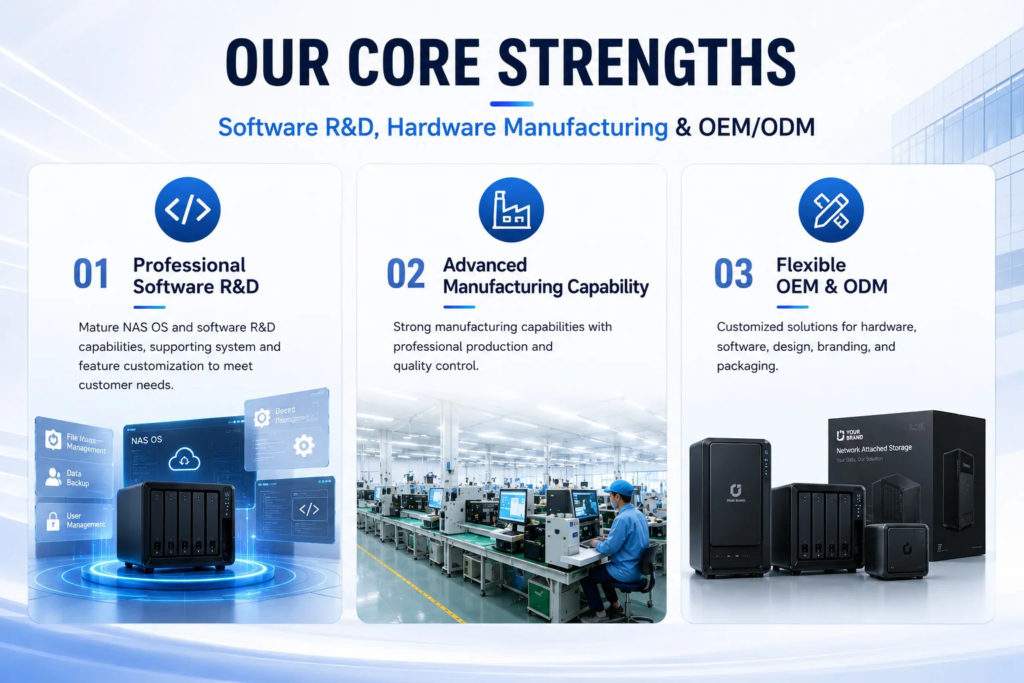
You do.
The white-label app is published under your own app store listing, which is the whole point of a private label arrangement.
That means your developer account, your screenshots, your privacy policy, and your review correspondence.
Apple’s App Store Review Guidelines are the document most brands end up reading twice, because the rules on data collection and permission prompts apply to a branded storage app in the same way they apply to any other app. ([Source: Apple, App Store Review Guidelines, queried October 16, 2026.])
A practical tip from watching this step go wrong: build the store listing before the first production run, not after.
Review cycles add calendar time that a packaging delay does not.
The interface itself can be branded too. Boot animation, UI elements, and the product naming shown inside the app are all configurable within the OEM program, which is the part oem-odm describes in full.
Set your own numbers and the arithmetic takes about a minute. The formula is units multiplied by the published unit price, plus any tooling invoiced separately, minus the sample credit.
Consider an illustrative case.
A brand commits to the published 100-unit minimum on the S2 at $195 per unit. The hardware commitment is 100 x $195 = $19,500 before freight and duties.
If the brand’s average sell-through is 12 units a week, that stock covers 100 / 12 = roughly 8.3 weeks of listing. Both inputs are illustrative here: the 100-unit floor and the $195 figure are published, while the weekly sell-through is the reader’s own estimate.
Weeks of cover is the number worth watching, not the order value. Eight weeks of cover gives you two full reorder cycles of feedback before the second purchase order, which is usually enough to learn whether the capacity promise in your copy is holding up.
Running a private label NAS for ecommerce brand range also means owning the parts question, because customers ask about drive compatibility before they ask about anything else.
The sample credit works in your favor here. Our OEM page states that samples are charged at the published single-unit price and that the amount is credited in full against the first production order, which means the evaluation units stop costing anything once that order is placed.
If the listing is priced for a two-bay buyer who wants a 2.5GbE port without paying four-bay money, products/s2-smart-nas fits that arithmetic most cleanly.
Packaging gets over-funded and support gets under-funded.
We see the same sequence in other hardware categories, so it is worth naming early.
A premium carton is visible on the day it arrives, so it feels like progress. A returns process is invisible until the first failed unit, and by then the cost of improvising it is a public review instead of an internal invoice.
If the budget only stretches to one extra project this quarter, spend it on the support and returns path rather than on a second SKU.
My reasoning is simple. A brand with one well-supported model can add a second model later, while a brand with two thin models has to fix both at once.
Three smaller items also get skipped often enough to be worth listing.
A supply arrangement and a one-off transaction look identical on a quotation. What separates them is whether the answers arrive in writing before the money does.
On volume, the OEM page states a program minimum of a per-project minimum for a reconfiguration of an existing platform, rising to 1,000 units once a new board respin or new tooling is involved. On samples, the unit is billed at the published single-unit price and the amount is credited in full against the first production order, so the evaluation stops costing anything once that order lands. On tooling, we either amortize the cost into the unit price or invoice it separately, and ownership passes to the buyer once it is paid.
Where a buyer needs confidentiality before the first conversation, a non-disclosure agreement is available and is typically countersigned within one working day.
The document set is the last practical item. Our product lines carry CE, UKCA, FCC, RoHS, REACH, and WEEE, and the pack that travels with a unit holds the CE declaration of conformity, the FCC Part 15 test report, and the RoHS and REACH declarations.
Then there is the question of where the work actually happens, which carries the most weight with buyers who plan to visit. Our research and development sits in Beijing, and our mass production runs in Shenzhen.
Buyers who want to verify that last answer usually start with the supplier questions collected in nas-manufacturing-usa-sourcing-guide, which are written from the buyer’s side of the table.
Each of those answers is cheaper to settle inside a quotation than inside a dispute, which is the only reason this list exists at all.
From a per-project minimum: white-label app, custom firmware, silkscreen or laser-engraved logo, market-specific documentation and packaging. Our export engineering team replies within one working day.
Key takeaways An FCC-recognized lab must hold the right scope for your device's rule part, not just any accreditation. A 2-bay NAS…
November 3, 2026Shared storage for deskside AI clusters refers to a storage appliance on the office LAN that holds datasets, checkpoints and embeddings for…
November 3, 2026A cloud storage subscription cost is the recurring fee a business pays to keep its files on a provider's servers, billed per…
Ask our export team for the OEM/ODM cooperation guide and a written quotation.
