Leo · 2026-10
A white label NAS for regional distributors is a reconfigurable storage platform sold under the buyer’s own brand, with a white label mobile app, branded enclosure and market-ready packaging. Four decisions define the program: which SKU ladder rungs to stock, what the first order costs in working capital, how deep the branding goes, and what the supply agreement has to state. woCyber, the export brand of a Beijing-based storage hardware manufacturer producing in Shenzhen, quotes these programs from 100 units per model. Tooling, packaging design and the app listing belong to the distributor; the board and firmware base stay with the factory.
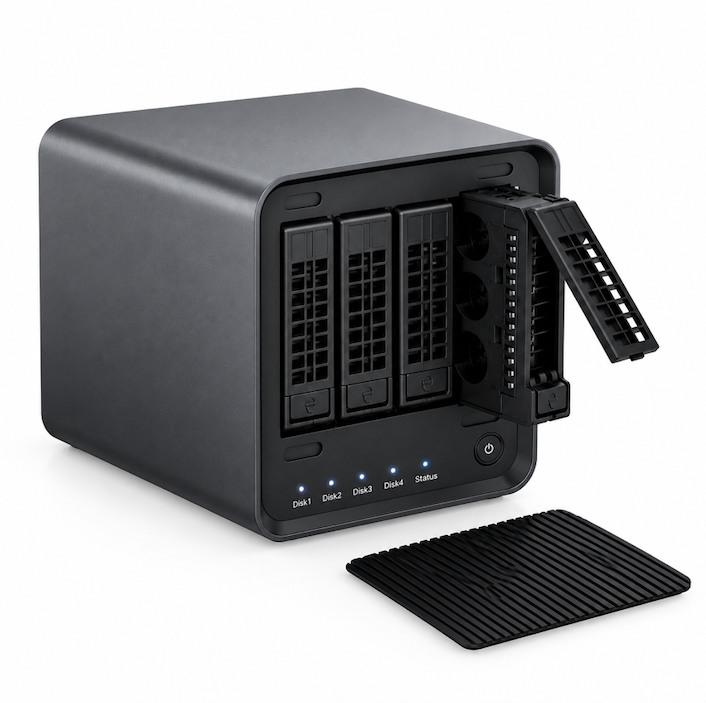
Scope note: this page covers what a distributor buys, rebrands and resells. The upstream question – how the factory applies a brand to firmware, app and packaging – is covered separately in the OEM/ODM overview oem-odm“>oem-odm.
Distributors rarely ask for a “NAS”. A distributor shopping for a white label NAS for regional distributors is asking for a catalogue line that fills a shelf position its current vendors leave empty, and it wants that line in its own name, so the SKU belongs to the distributor and not to the factory. The shelf positions that tend to be open sit at the entry end and at the 4-bay end of a catalogue rather than in the middle. That is the whole commercial idea behind a white label NAS program. Everything else – branding rights, tooling, firmware branches, certification files – is the detail that decides whether the program is workable or becomes an argument eighteen months later.
Four rungs cover the range a regional catalogue is usually asked about. Below four, the catalogue cannot answer the buyer enquiries it already receives; above four, the distributor carries stock it cannot turn over.
| Rung | Typical role in the catalogue | Platform characteristics | Published single-unit reference price |
|---|---|---|---|
| Rung 1 – entry | First NAS for a household or a single practitioner | A3 Pro: 1 bay, RK3566, 32 GB eMMC boot storage, up to 30 TB, 1xGbE, HDMI 4K@60 | $150 |
| Rung 2 – volume | The line the distributor sells most of | A2 Pro: 2 bays, RK3568 with a 1 TOPS NPU, 4 GB DDR4, up to 48 TB, RAID 1, ONVIF | $170 |
| Rung 3 – multigigabit | Buyers whose current 1 GbE link is the bottleneck | S2: 2 bays, 1×2.5GbE, up to 60 TB, ABS with a rigid steel mid-frame | $195 |
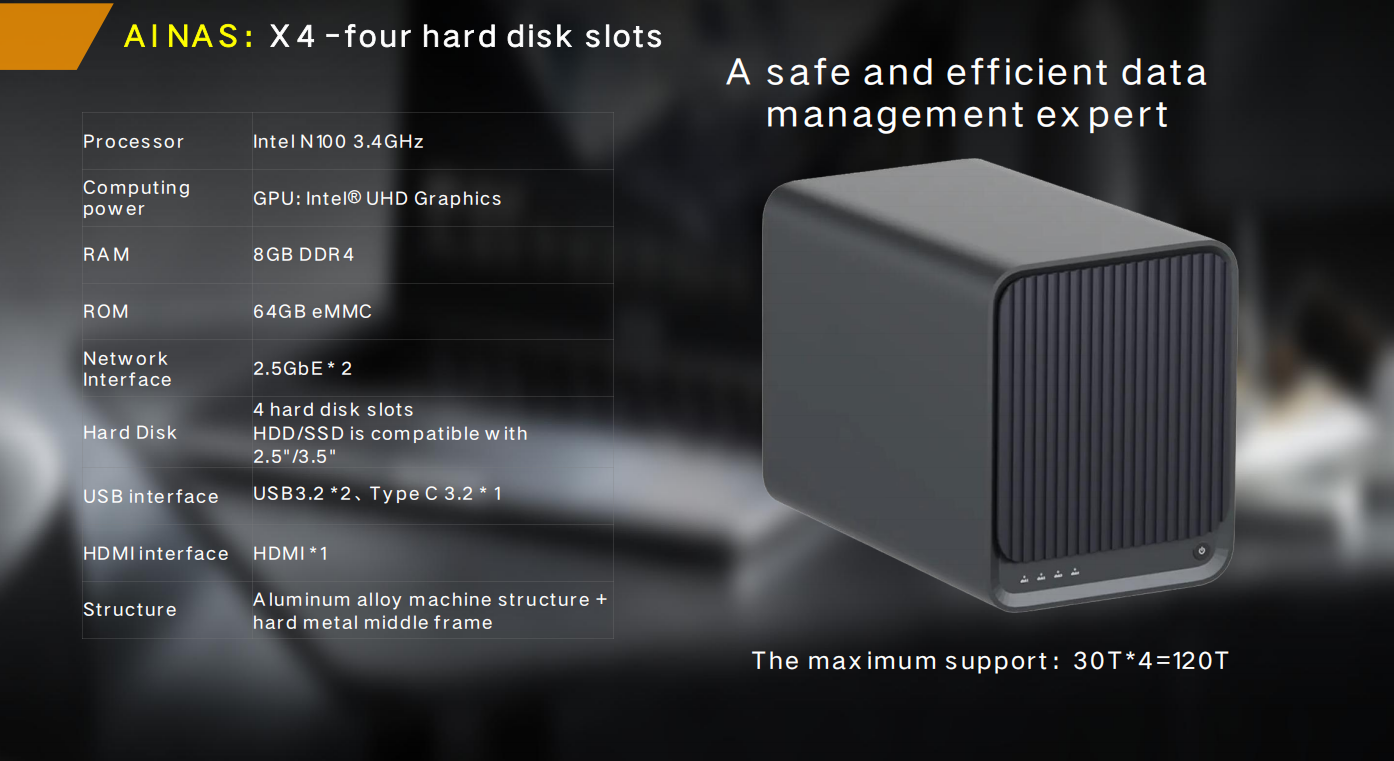
| Rung 4 – 4-bay | Small studios, integrators, multi-drive enquiries | X4: 4 bays, Intel N100, 2×2.5GbE ports with link aggregation and failover, RAID 0/1/5/6/10, up to 120 TB | $400 |
Prices are published single-unit reference prices in USD, excluding shipping and tariffs. Volume and OEM pricing is quoted per program and on request, MOQ 100 units per model.
The order of the rungs matters more than any single specification. A distributor that launches rung 4 first spends working capital on a slow-turning box; a distributor that launches rung 2 first finds out whether the region buys capacity or throughput before committing to the wider model. The ladder is also the sales argument: the buyer who starts at rung 1 has a reason to come back for rung 2 without changing vendor.
The useful calculation for a first order returns the capital required rather than the unit cost, because working capital is what actually limits the order size.
Inputs (illustrative, not quoted figures):
Planned monthly sell-through S = 60 units | Target months of cover M = 2 | Blended landed unit cost C = illustrative only — supplier pricing is quoted per program
Formula: Order quantity Q = S x M -> Tied-up capital = Q x C
Worked example: Q = 60 x 2 = 120 units; at an illustrative landed cost of $180 per unit the tied-up capital is 120 x $180 = $21,600. The 120-unit figure sits just above the 100-unit platform reconfiguration threshold, so the order lands in the reconfiguration tier rather than a small-quantity tier. Substitute your own quoted cost to run the same arithmetic.
Second formula – why the payment schedule matters to a distributor: Cash out at order = 30% x Q x C, so 0.30 x $21,600 = $6,480 leaves the business before the goods move. The payment terms published by woCyber call for a deposit with the order and the balance against the bill of lading, which means the remainder is released against a document proving the goods are on the water rather than at the point of order.
Two components sit outside the unit cost and are worth flagging to whoever signs the order. The first is the sample-stage outlay: samples are charged at the published single-unit price, and that amount is credited in full against the first bulk order, so the sample cost is a timing cost rather than a sunk cost. The second is any non-recurring engineering. NRE is quoted per project and can be credited against agreed volume, which means the distributor pays for it once the program works instead of before.
Ownership is where white label programs go wrong, and the answer is narrower than most distributors expect.
| Item | Holder | What makes it real |
|---|---|---|
| Product name and packaging design | Distributor | The shipped carton, insert and label carry the distributor’s brand only |
| White label app listing | Distributor | Submitted to the app stores under the distributor’s own developer account |
| Industrial design and tooling | Distributor, once paid | Amortized into the unit price or invoiced separately; ownership transfers on final payment |
| Reuse of customer-specific tooling | Distributor | Tooling built for one customer is not reused for another |
| Underlying hardware platform | Factory | The SoC, board layout and firmware base remain the factory’s platform |
| Catalogue of standard models | Factory | Standard platforms stay available to other buyers unless territory exclusivity is agreed in writing |
The bottom two rows are the ones to read twice. A white label program reconfigures an existing platform; it does not create an exclusive product. If a distributor wants its SKU to be the only box of that specification in its territory, that has to be negotiated as territory exclusivity against a committed annual volume and written into the distribution agreement. Rebinding the logo does not create it.
A distributor that already sells consumer storage but moves every unit under somebody else’s brand owns the customer and not the product. Working from the ladder above, the trade-offs sit in three places rather than one.
Storage configuration comes first: a distributor can stock chassis only and let retail partners fit drives, which lowers tied-up capital but pushes the sizing conversation onto the retailer. Branding depth comes second: a compact 2-bay platform can carry the distributor’s name on the sheet metal, the carton and the app while the board and firmware base stay with the factory, which means the SKU is branded but not exclusive. Launch order comes third: the volume rung gives a faster read on sell-through, whereas the 4-bay rung chases higher-ticket integrator enquiries while tying up more capital per unit.
The sequencing rule that follows from this is straightforward. Launch on the rung that turns over fastest, hold the 4-bay rung for quoted integrator projects rather than shelf stock, and revisit the whole ladder once two quarters of sell-through data exist. That order keeps the first order inside the reconfiguration tier at 100 units per model, which also settles, at the lowest capital exposure, whether the region buys capacity or throughput.
Branding moves in steps, and each step has a different cost driver, which is why “can you put our logo on it” is rarely a yes-or-no question.
Increments one to four sit inside the platform reconfiguration tier at 100 units per model. What pushes a white label NAS program to the 1,000-unit threshold is a new printed circuit board respin or new enclosure tooling – a change to the physical platform rather than to the brand layer on top of it. Knowing which side of that line a requested change falls on is worth settling before the first technical call rather than after it.
The documentation set is fixed for a standard configuration and partly program-specific for a branded one, so it is worth separating the two. This is also the point at which a white label NAS for regional distributors stops being a price conversation and becomes a compliance one.
For the hardware, the compliance file covers CE, UKCA, FCC, RoHS, REACH and WEEE, alongside an ISO 9001 quality-system certificate and an ONVIF conformance declaration. For a North American retail launch, the FCC Part 15 test report and the manufacturer’s declaration are the two documents a retailer’s compliance desk is most likely to request, because radio-frequency equipment authorization attaches to the hardware and radio module, not to the brand printed on the carton.
For a branded program, the distributor should additionally expect retail barcodes (EAN or UPC as applicable), country-of-origin marking, WEEE and producer-responsibility labelling for the destination market, and packaging documentation in the market’s language. Quality records travel per batch: production runs are backed by 100% outgoing inspection with reports archived per batch, and units pass a 72-hour burn-in before shipment. Third-party factory audits – SGS, Bureau Veritas or TÜV – can be arranged, including video walkthroughs and engineer visits during a production run.
Six clauses carry most of the risk in a white label arrangement, and all six are negotiation points rather than standard terms.
| Clause | What it should say |
|---|---|
| Ownership of tooling | Amortized into the unit price or invoiced separately, with ownership transferring to the distributor on final payment |
| Non-reuse of customer-specific tooling | Tooling built for this distributor is not reused for other clients |
| App listing and developer account | The white label app is published under the distributor’s developer account and brand |
| Territory exclusivity | Requested in writing against a committed annual volume; whether it is granted, and for which configuration, is settled case by case in the agreement |
| Warranty and spares | Three years on hardware, with spare-part supply for the project lifecycle |
| Payment schedule | 30% with the order, 70% against the bill of lading |
Two of these deserve a sentence of explanation. Territory exclusivity is the clause distributors most often assume they hold and often do not: it has to be requested in writing against a committed volume, and it should name the configuration rather than the brand, because a standard platform remains available to other buyers by default. Warranty and spares is the second clause that decides whether the program survives year three: a three-year hardware warranty is only as valuable as the spare-part supply behind it, and supply for the project lifecycle is the part worth writing down separately.
Most white label programs fail on one of three points, and all three are cheaper to settle before the purchase order than after it.
For a distributor weighing two rungs against four, the hardware is the cheapest thing to change later: a 4-bay platform such as products/x4-nas-server“>x4-nas-server covers the integrator and small-studio end of a catalogue while a compact 2-bay platform covers the volume rung, and both run from the same branding toolkit of logo, interface, app and packaging. The decision worth slowing down on is the territory clause, not the chassis. Distributors comparing this structure against a straight wholesale arrangement can work through the buy-side mechanics in our guide to nas-distributor-wholesale-program-north-america“>NAS distributor wholesale programs in North America.
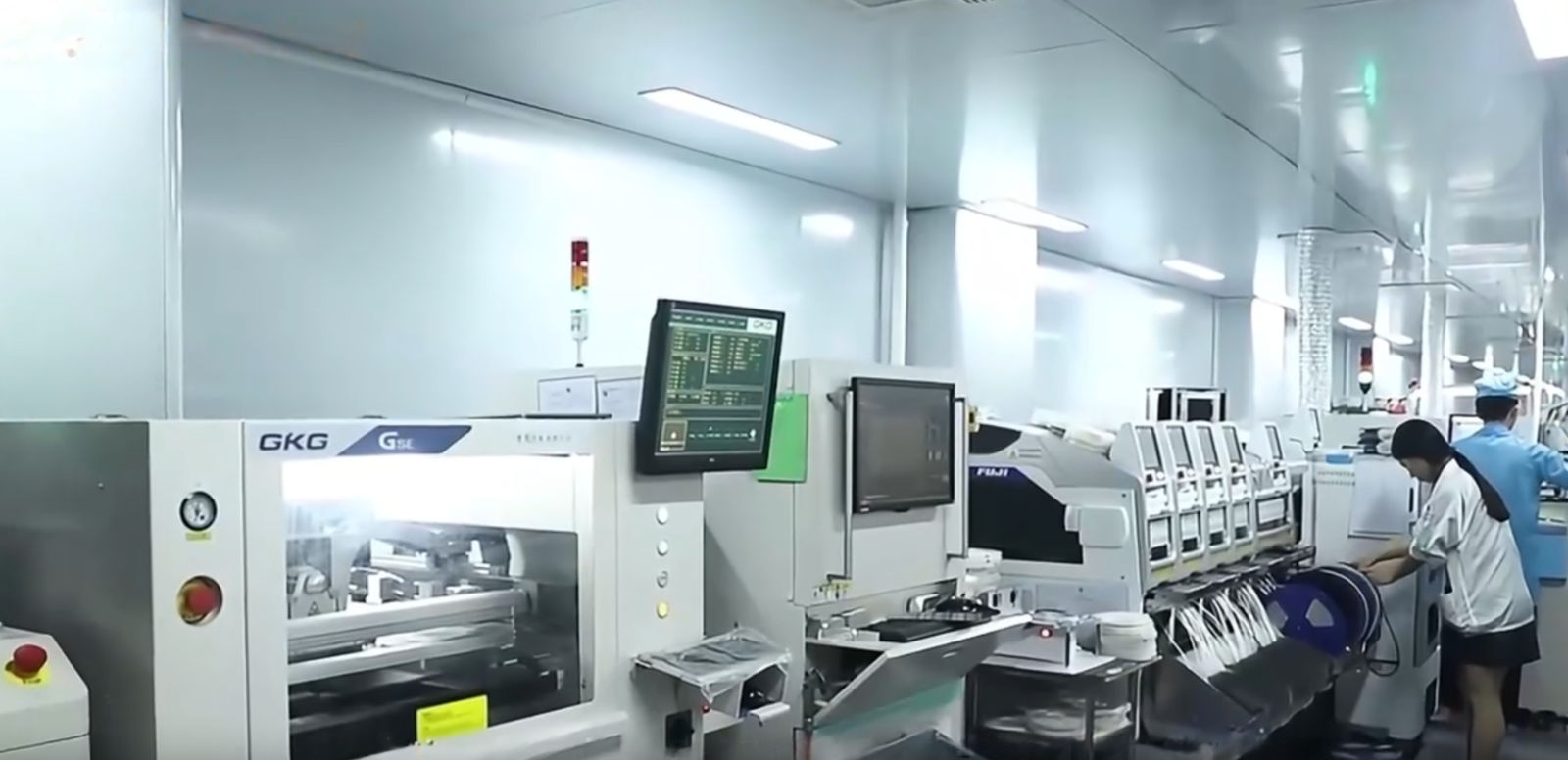
We are the factory: SMT to shipment under one roof, R&D in Beijing, mass production in Shenzhen. Factory-direct pricing without trading-company markups.
Retail NAS SKU for Big Box Channel Partners: How Retailers Specify a Storage Line A retail NAS SKU for big box channel…
September 30, 2026NAS Manufacturing USA: Sourcing Guide for 2026 Brands Most NAS manufacturing USA comparisons start with the assembly line. The invoice disagrees. On…
September 30, 2026NAS Manufacturer for Enterprise: 2026 Selection Checklist A procurement team that picks the storage platform and the storage supplier in the same…
Ask our export team for the OEM/ODM cooperation guide and a written quotation.