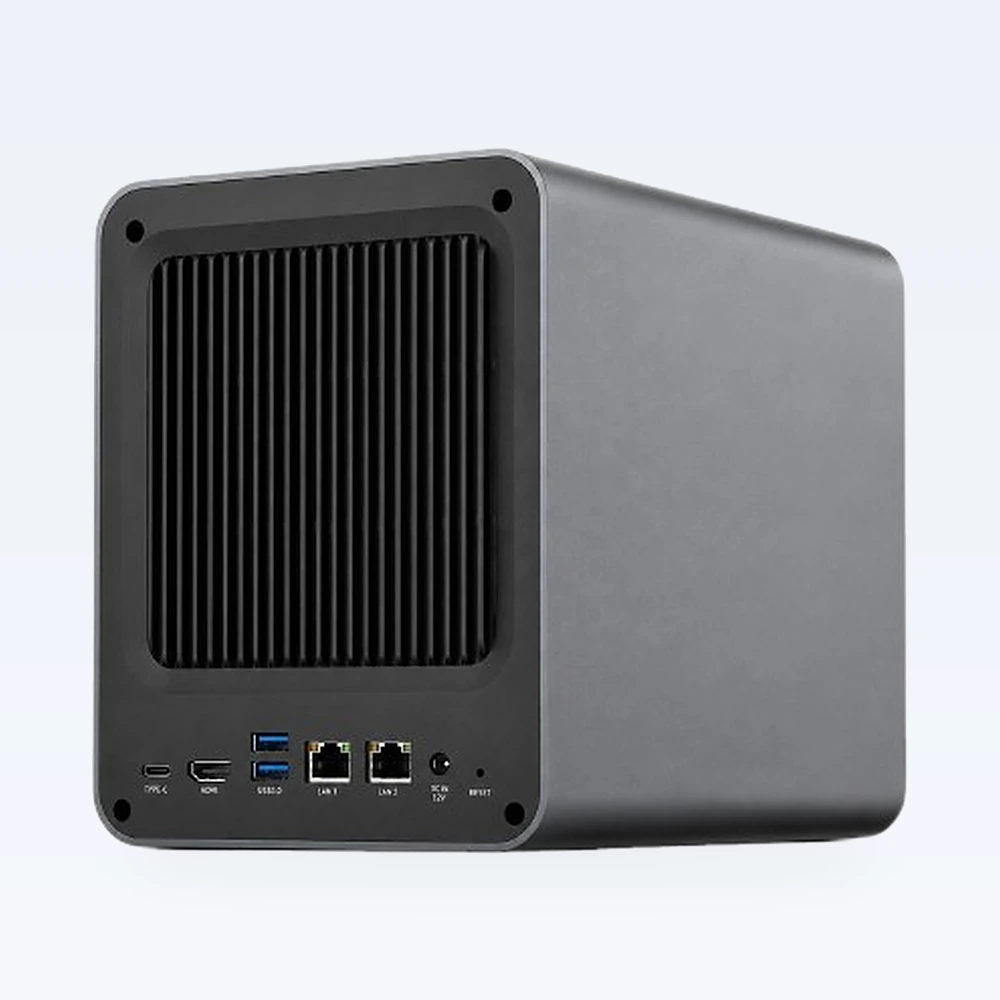
Intel N100 · 2× 2.5GbE · 4 bays · up to 120 TB
Volume & OEM pricing on request. Excluding shipping and duties; subject to change.
Sample fee is credited to your first bulk order. Shipping is calculated at checkout; import duties are billed separately.
Built for brand owners and integrators who need a credible mid-range enterprise NAS. The X4 is the platform we recommend for SMB file servers, surveillance recording back-ends, media production archives and on-premise private cloud — the configuration that competes directly with mainstream 4-bay commercial NAS units.
X4 in one paragraph: X4 is woCyber’s four-bay OEM/ODM NAS platform: Intel N100, 8 GB DDR4, 64 GB eMMC, four SATA bays, up to 120 TB raw capacity, 2 × 2.5GbE and RAID 0/1/5/6/10. It is supplied as a private-label base for brand owners and integrators; OEM scope and MOQ are confirmed in writing at quotation. Quote a Config ID →
The X4 is the four-bay tier of the platform family, supplied to brand owners and integrators as an OEM/ODM base. Deployment patterns for backup targets and virtualisation-lite hosts are set out on the virtualisation and backup target OEM page. The answers below use the published specification only; anything not listed here is confirmed by your project owner at quotation.
Base build: an Intel N100 processor, 8 GB DDR4 memory, 64 GB eMMC boot storage, four tool-free 2.5-inch or 3.5-inch SATA trays, a 120 TB raw capacity ceiling, two 2.5GbE RJ45 ports, USB 3.2 and Type-C connectivity, and HDMI output at 4K@60 Hz. RAID 0, 1, 5, 6 and 10 are supported, and the chassis is aluminum over a steel mid-frame with active multi-fan thermal control. Every item in that list is reconfigurable on an OEM basis, including NVMe cache bays and 10GbE port mixes.
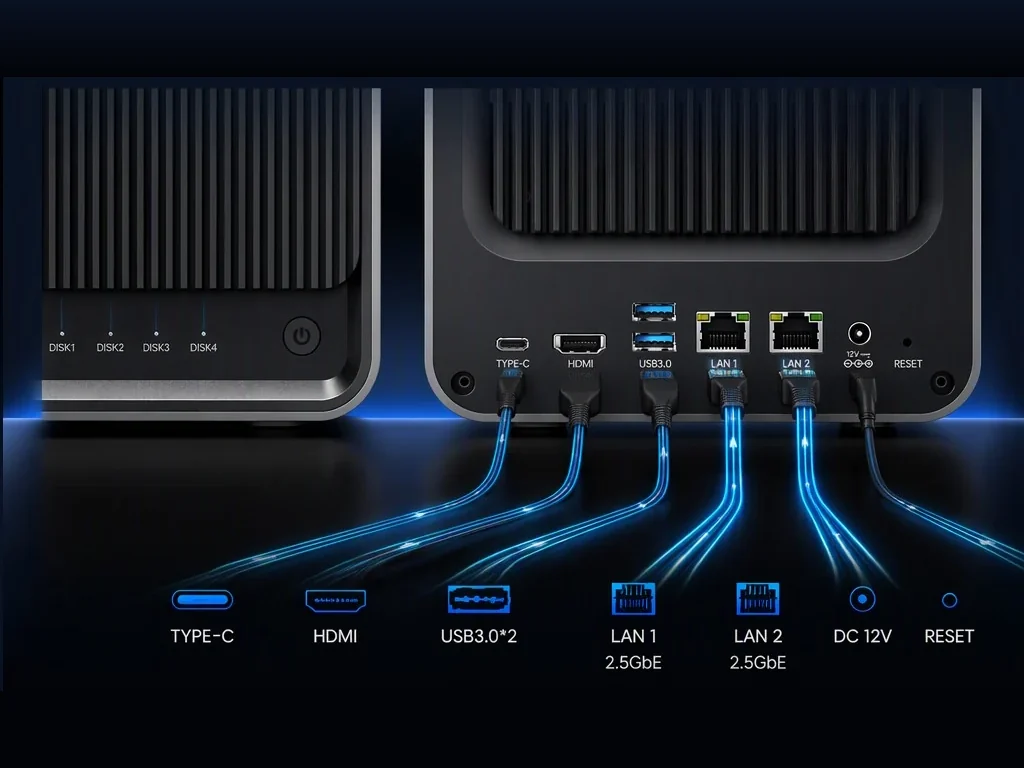
Two independent 2.5GbE ports support 802.3ad link aggregation and failover, giving up to 5 Gbps of aggregated interface bandwidth for concurrent multi-user workloads, with hardware 4K transcoding handled on the platform. Those are interface rates rather than measured transfer speeds: sustained throughput depends on drives, RAID level, file sizes and client hardware, so it is best verified on your own workload. Port mixes of 1GbE, 2.5GbE and 10GbE are available under OEM configuration.
Yes. A white-label app listed under your brand, branded UI and boot animation, logo by silkscreen or laser engraving, market-specific documentation and packaging, and regional power adapter variants all sit inside the standard OEM/ODM scope. Reconfiguration orders on an existing platform are confirmed per project in writing; a project that needs a new PCB respin or new enclosure tooling is quoted per project. The X4 is published at a single-unit reference price of $400 excluding shipping and duties, and volume or OEM pricing is quoted on request. See published platform pricing and the OEM/ODM program.
The platform is specified for containerised applications and virtualisation-lite workloads on an Intel N100 with 8 GB DDR4, expandable to 16 GB under OEM configuration, and it exposes two 2.5GbE ports that aggregate to 5 Gbps. Whether it fits a given backup or virtualisation design depends on the protocol mix, the number of concurrent jobs and the retention window, so those three inputs are confirmed against your workload at quotation rather than assumed from the platform class. A four-bay chassis with a 120 TB ceiling supplies the capacity headroom; the software layer is the part that has to be matched to the existing stack.
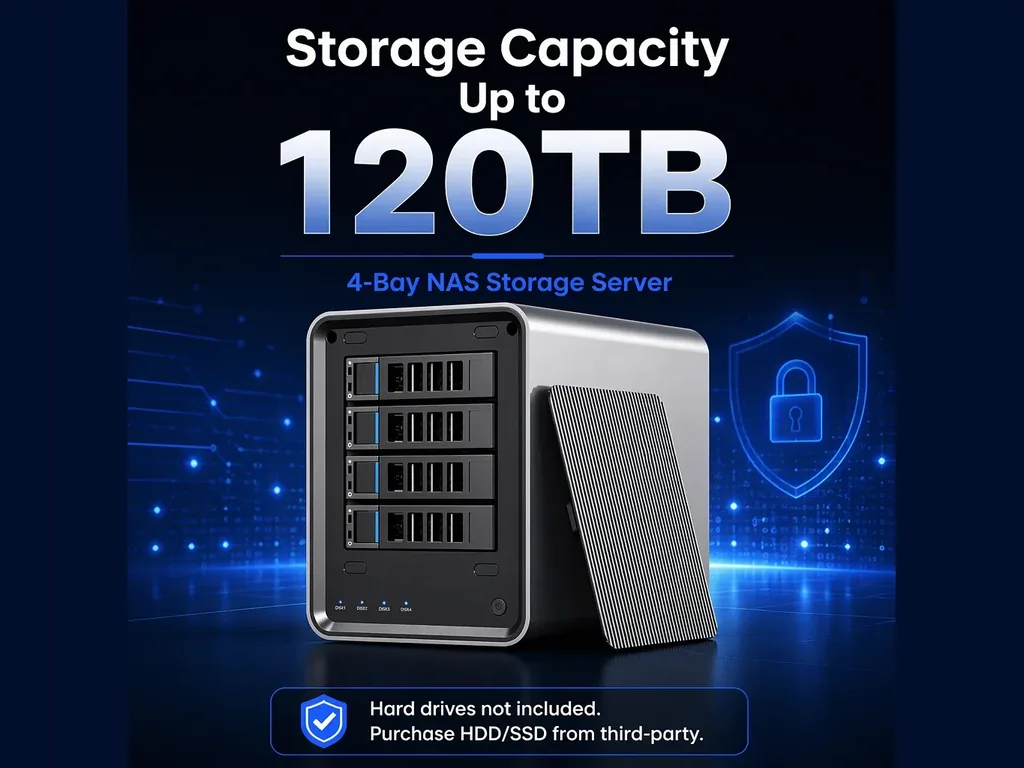
Raw capacity is 120 TB, built from four 30 TB drives. RAID 0 exposes all 120 TB with no redundancy. RAID 5 leaves 90 TB usable and tolerates one drive failure. RAID 6 and RAID 10 each leave 60 TB, with RAID 6 tolerating two failures and RAID 10 pairing mirrored drives. A hot spare removes one further drive from the usable total, and file-system overhead takes a small additional share, so a volume should be planned against usable rather than raw capacity.
A traditional NAS mainly stores and shares files across the network. woCyber AI NAS adds an on-device compute unit that runs inference locally, so face and object recognition, local document summarization, and small model question answering run on the appliance without a per-use cloud API fee.
Yes. woCyber builds private-cloud and AI NAS hardware as OEM/ODM: industrial design, PCB and interface customization, firmware and UI, and branded chassis and packaging. Minimum order quantity is confirmed per project in writing.

Face, scene and event models run on the device. AI features keep working without an internet connection and without uploading data.

Storage is local and account-isolated. No mandatory cloud dependency, no third-party access to customer data.
Encrypted remote access through mobile app, desktop client and web portal — relayed or peer-to-peer, under your branded service.
Independent accounts with isolated storage spaces and per-user permissions — one appliance serves a household or a team.
ONVIF / PoE IP camera support with AI event classification on the appliance — surveillance and storage in one system.
| Dual 2.5GbE with link aggregation | Two independent 2.5-gigabit Ethernet ports support 802.3ad link aggregation and failover, delivering up to 5 Gbps aggregated bandwidth for concurrent multi-user workloads. |
|---|---|
| x86 architecture, Linux NAS OS | Intel N100 with 8 GB DDR4 supports containerised applications, virtualisation-lite workloads, hardware transcoding and the full container/app ecosystem — the most extensible platform in the line-up. |
| Tool-free four-bay architecture | Independent per-bay activity indicators and hot-swap trays allow capacity expansion and drive replacement without downtime or tools — a serviceability requirement for integrator deployments. |
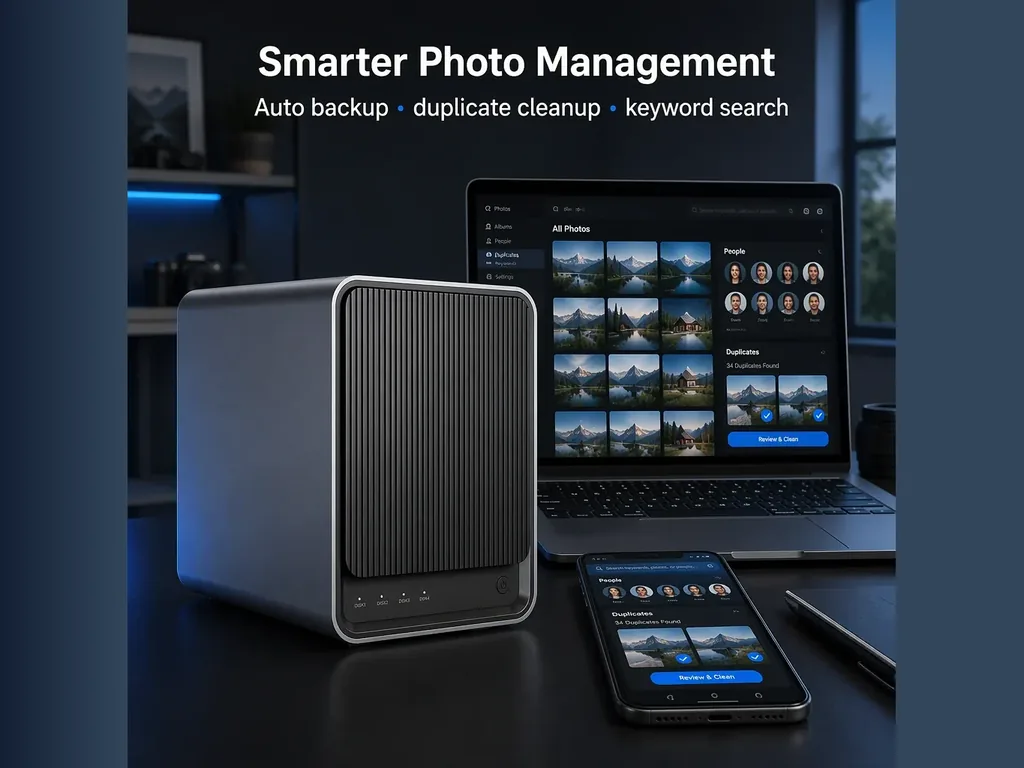
| AI media indexing | On-device face recognition, scene classification and automatic phone backup indexing keep large photo libraries searchable without sending data to a third-party cloud. |


Base configuration. All items below are reconfigurable on an OEM basis.
| Processor | Intel N100 — 4 cores, up to 3.4 GHz |
|---|---|
| Graphics | Intel UHD Graphics — hardware 4K transcoding |
| Memory | 8 GB DDR4 |
| Boot storage | 64 GB eMMC |
| Drive bays | 4 × 2.5" / 3.5" SATA HDD or SSD, tool-free hot-swap |
| Maximum capacity | 120 TB raw (30 TB × 4) |
| Network | 2 × 2.5GbE RJ45, link aggregation & failover |
| Expansion | USB 3.2 ×2, USB Type-C 3.2 ×1 |
| Display out | HDMI ×1 |
| Chassis | Aluminium alloy body with steel mid-frame |
| Cooling | Active multi-fan with automatic thermal control |
| RAID & protection | Single / JBOD / RAID 0 / RAID 1 / RAID 5 / RAID 6 / RAID 10 (firmware dependent) |
Certifications: Documentation per model — request the pack · Cases
| Industrial design | Enclosure colour, surface finish and front-bezel treatment; optional custom ID work for programmes above 3,000 units |
|---|---|
| Branding | Laser-engraved or silkscreen logo on bezel and rear panel; branded drive-tray labels |
| Hardware configuration | RAM up to 16 GB, eMMC up to 128 GB, 1GbE / 2.5GbE / 10GbE port mixes, optional NVMe cache slot |
| Firmware | Branded web UI, custom login and boot splash, branded OTA update channel, feature gating and default service set |
| Clients | White-label mobile app (iOS / Android), desktop client and web portal under your brand |
| Packaging | Retail-grade colour box, moulded EPE or pulp inserts, multilingual quick-start guide and accessory set |
| Compliance | CE / UKCA / FCC / RoHS / REACH / WEEE test support against your destination markets |
Tell us your market and volume — we reply with the datasheet and a configuration proposal.
