Leo · 2026-10
Choosing an agentic AI workload storage supplier comes down to what can be verified: memory headroom for the retrieval index, a network path fast enough for parallel agent reads, tiering that keeps hot vectors close to compute, and access control that can be audited. US buyers should ask for published specifications rather than roadmap claims.

An agentic AI workload is a software process in which a model plans its own steps, calls tools, and reads or writes data without a human prompt at every turn. For a storage buyer, the practical consequence is that the appliance stops being a file cabinet and starts behaving like an index server.
woCyber is the export brand of a Beijing-based storage hardware manufacturer, with research and development in Beijing and mass-production manufacturing in Shenzhen. The company builds NAS platforms and edge appliances for system integrators, regional distributors, and private-label brands, and it does not run a competing consumer retail line.
Three characteristics separate agentic workloads from ordinary file sharing, and each one maps to a different hardware decision:
Everything a buyer needs to verify follows from those three characteristics, from the specification numbers a supplier publishes to the factory evidence that sits behind them.
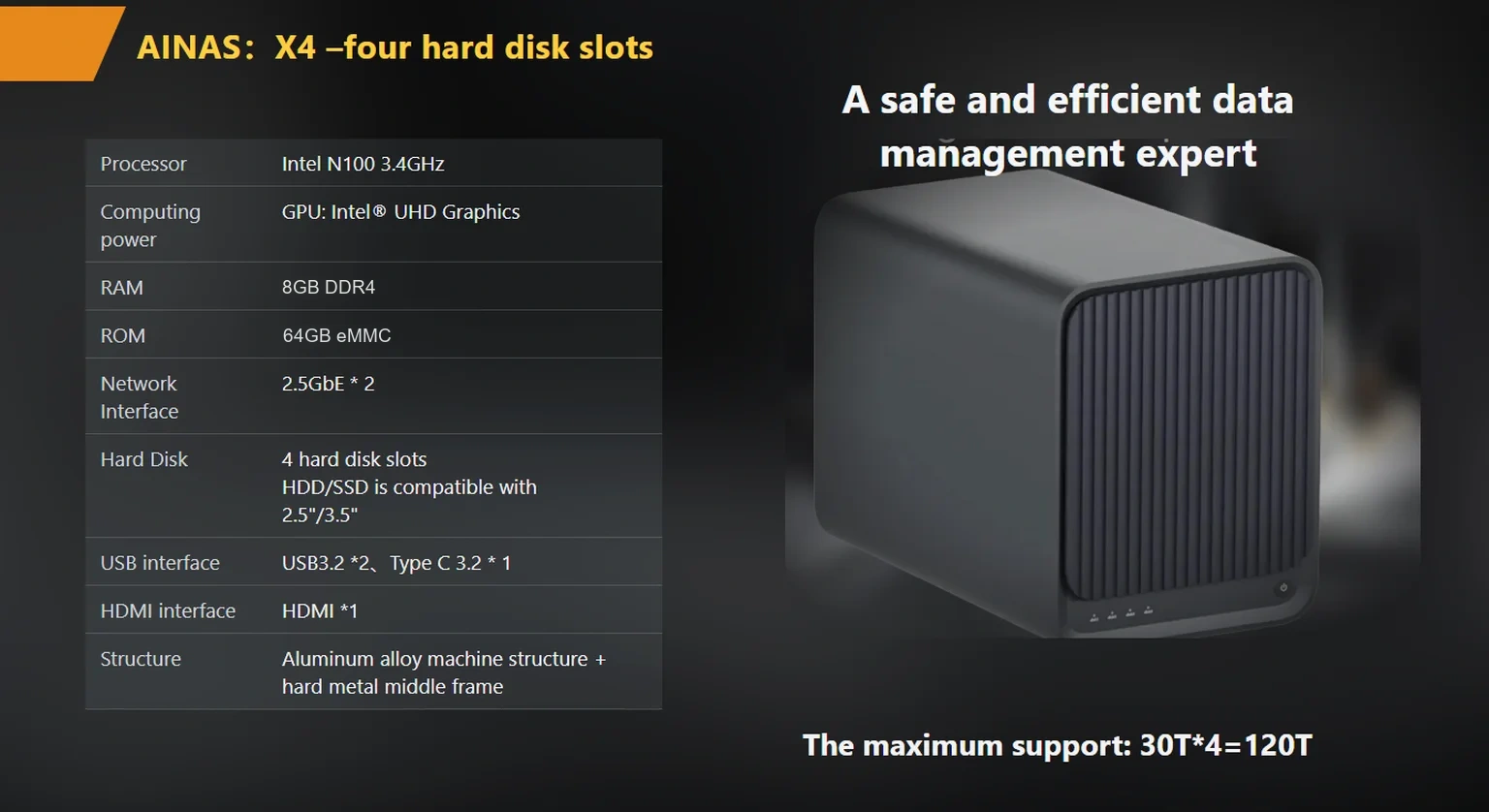
The published X4 specification lists the numbers a US buyer should ask every candidate supplier to match: an Intel N100 processor, 8 GB DDR4 memory with OEM configurations up to 16 GB, 64 GB eMMC boot storage with OEM options up to 128 GB, four drive bays, and a 120 TB capacity ceiling.
Two of those figures decide whether an agentic pilot is feasible at all. Memory sets the largest resident retrieval index the platform can hold, and boot storage sets how many container images the device can keep side by side without falling back to a slower path.
A platform that cannot keep its index resident will read from disk on every retrieval call. In practice this is the most common cause of a proof of concept that works with one agent and stalls with six, which is why memory headroom deserves more attention than bay count in an agentic rollout.
For teams that want an x86 platform with container support, products/x4-nas-server is the model worth placing beside a competitor sheet, because a published figure is one the buyer can later check against the batch test records that travel with the order.
Most agentic deployments meet a network ceiling long before they meet a capacity ceiling. A single 1GbE link carries roughly 125 megabytes per second at line rate, which is comfortable for file sharing and tight for parallel index reads across several agents.
The published X4 specification lists two 2.5GbE ports with link aggregation and failover support reaching up to 5 Gbps, plus OEM options for mixing 1GbE, 2.5GbE, and 10GbE. The published S2 specification lists one 2.5GbE port. Multi-gigabit behavior over twisted-pair cabling is standardized in the IEEE 802.3 family, which is why a 2.5GbE port attached to an older switch negotiates down to 1GbE instead of failing outright (IEEE 802.3 Ethernet Working Group).
Buyers over-specify bays and under-specify the network path, and that habit is expensive. Four empty bays add no throughput, while a second 2.5GbE port with aggregation can double the read path for every agent on the segment without touching the drive configuration.
Index size does not change with the network, but the time an agent waits for each retrieval does. That waiting time is the number a user actually notices, and it is set by the path between the appliance and the compute node.
A retrieval index needs memory in proportion to vector count and dimensions, not in proportion to the size of the source documents. That distinction is where most agentic budgets go wrong, because text compresses and vectors do not.
Worked example (illustrative): a firm indexes 2,000,000 document chunks as 768-dimension embeddings stored as 4-byte floats. Raw vector data is 2,000,000 x 768 x 4 bytes = 6.14 GB. Index overhead depends on the index type selected, so the working set should be planned as raw vector data multiplied by an overhead factor that the buyer measures on its own data; this illustration uses 1.5, which puts the working set near 9.2 GB. A platform published with 8 GB DDR4 cannot hold that index resident, while the same platform configured to the published OEM ceiling of 16 GB can.
The same arithmetic scales down. An operation indexing 400,000 product chunks lands near 1.8 GB of working set, which fits a compact platform comfortably. What changes between the two cases is not the document count but the query concurrency: ten parallel agents reading one index need that index resident, not merely stored.
For mixed workloads where a department shares files and runs a small index on one device, products/s2-smart-nas is the two-bay option worth reviewing, since the published S2 specification lists a 60 TB capacity ceiling, 4 GB DDR4 memory, and a 1 TOPS NPU for on-device inference.
When an agent reads data, each retrieval becomes an access event that has to be attributable to an account. That is why access logging moves from nice-to-have to purchase-order line item in regulated industries, and why buyers ask where the log lives.
Local deployment with access auditing is a published woCyber property: the data and the access record can stay on hardware the customer operates and can inspect. Where a project needs stronger separation between users, per-account physical isolation is published for the S1 appliance and can be specified and confirmed in writing for other models. Buyers should treat both as structural properties to verify rather than certificates to collect, which is also the discipline NIST applies when it separates storage security controls from product marketing in its storage security guidance (NIST SP 800-209).
The woCyber product lines are certified CE, UKCA, FCC, RoHS, REACH, and WEEE. Frameworks such as GDPR or HIPAA are supported through local deployment and access auditing; a framework is not a certification, and no supplier should present the two as interchangeable.
A specification sheet describes one unit. A supplier describes the ten-thousandth unit, and that is where project risk actually sits.
Four supplier facts can be checked

before a purchase order is issued. The company reports 15+ years of OEM/ODM storage experience, 500K+ units shipped, and 30+ export markets. Samples are charged at the published unit price and credited in full against the first mass-production order. A non-disclosure agreement is typically countersigned within one working day. The minimum order quantity is a per-project minimum, rising to 1,000 units only when a new PCB respin or new tooling is required.
Manufacturing evidence follows the same pattern. The factory page describes SMT lines, assembly, functional testing, a 72-hour burn-in room, and 100 percent outgoing inspection with batch-archived reports. For an agentic rollout, burn-in is the most important of these, because a platform that fails under sustained write load fails after deployment rather than before it.
Private-label and OEM programs are documented on the oem-odm page, covering white-label applications, branded interfaces, logo application by silkscreen or laser engraving, and localized documentation and packaging. Buyers who intend to ship the platform under their own brand should confirm those items at quotation stage rather than after tooling begins.
The table below compares the two published platforms most often shortlisted for US agentic pilots. Values come from the published specifications; anything the manufacturer has not published is marked as such rather than estimated.
| Published specification | X4 | S2 |
|---|---|---|
| Drive bays | 4 | 2 |
| Processor | Intel N100 | RK3568 with 1 TOPS NPU |
| Memory | 8 GB DDR4, OEM up to 16 GB | 4 GB DDR4 |
| Boot storage | 64 GB eMMC, OEM up to 128 GB | 32 GB eMMC |
| Network | 2 x 2.5GbE, link aggregation up to 5 Gbps | 1 x 2.5GbE |
| Capacity ceiling | 120 TB | 60 TB |
| RAID levels | 0 / 1 / 5 / 6 / 10 | Not published |
| Drive support | 2.5 in / 3.5 in SATA HDD or SSD, tool-less trays | Not published |
| Container workloads | Supported | Not published |
| Volume terms | On request, volume supply on request | On request, volume supply on request |

Consider a hypothetical 30-person US accounting practice deploying an internal research agent across 250,000 client files. Its constraint is not capacity, because 250,000 documents occupy only a few hundred gigabytes. Its constraint is the index working set plus the number of concurrent agent queries during filing season. A four-bay platform would be oversized on storage and correctly sized on network, while a two-bay platform would be right on storage and marginal on concurrent reads. The deciding number is the index working set, and the trade-off is headroom against the cost of capacity nobody will fill.
That is also the discipline the NIST AI Risk Management Framework applies to AI systems themselves, where documentation and monitoring count as core requirements rather than optional extras (NIST AI RMF). The same discipline applies one layer down: a storage claim that cannot be checked against a published specification is not yet an answer, it is a promise.
Buyers who want the wider argument behind the network section will find it in why-storage-is-the-ai-bottleneck, which explains why storage and its interconnect usually set the ceiling on AI projects. Teams weighing a hosted model against a local platform will find the cost structure laid out in ai-nas-vs-cloud-storage-small-business, and those planning resilience around the index should review ai-nas-backup-systems before choosing a backup cadence.
A billed sample then does the rest of the work. Sample units are charged at the published unit price and the fee is credited in full against the first mass-production order, which turns the index-size and network questions into measurements on the buyer’s own data instead of estimates taken from a summary sheet. For the compliance documents that have to travel with the order, the published set is CE, UKCA, FCC, RoHS, REACH, and WEEE, and order-specific terms are confirmed in writing at quotation.
We are the factory: SMT to shipment under one roof, R&D in Beijing, mass production in Shenzhen. Factory-direct pricing without trading-company markups.
Key takeaways An FCC-recognized lab must hold the right scope for your device's rule part, not just any accreditation. A 2-bay NAS…
November 3, 2026Shared storage for deskside AI clusters refers to a storage appliance on the office LAN that holds datasets, checkpoints and embeddings for…
November 3, 2026A cloud storage subscription cost is the recurring fee a business pays to keep its files on a provider's servers, billed per…
Ask our export team for the OEM/ODM cooperation guide and a written quotation.
