Leo · 2026-10
An on-premises LLM NAS is a network storage appliance sized to hold a language model and its retrieval index on the same box that serves files, so inference runs inside the customer’s own network instead of through a metered cloud API. For a US brand planning to sell one, the sourcing decision turns on three platform numbers — memory ceiling, boot storage and network ports — plus the OEM contract terms around firmware, app branding and tooling ownership.

woCyber is the export brand of a Beijing-based storage hardware manufacturer (headquarters and R&D in Beijing, volume manufacturing in Shenzhen) building NAS and edge AI appliances for OEM and ODM partners: 15+ years in storage manufacturing, 500K+ units shipped, 30+ export markets.
The term covers a class of appliance built around one constraint: the model and its index have to be reachable on the same network as the documents they answer questions about, with no request leaving the building. Memory, boot storage and port layout are the three specifications that make that possible.
For an OEM buyer the question is really a platform question, and buyers split into three groups. A systems integrator bundling a private AI appliance into client deployments cares about remote serviceability and a stable software image. A US brand launching its own line cares about branding control and the documentation pack. A company engineering a private knowledge base cares about the memory ceiling and the capacity ceiling, because those decide what it can run next year without buying again.
For an on-premises LLM NAS OEM program the three decisive numbers are memory maximum, boot storage size and port layout, because a local model and its retrieval index are constrained first by addressable memory, second by whether services can be updated in place, and third by whether more than one user can query the same box.
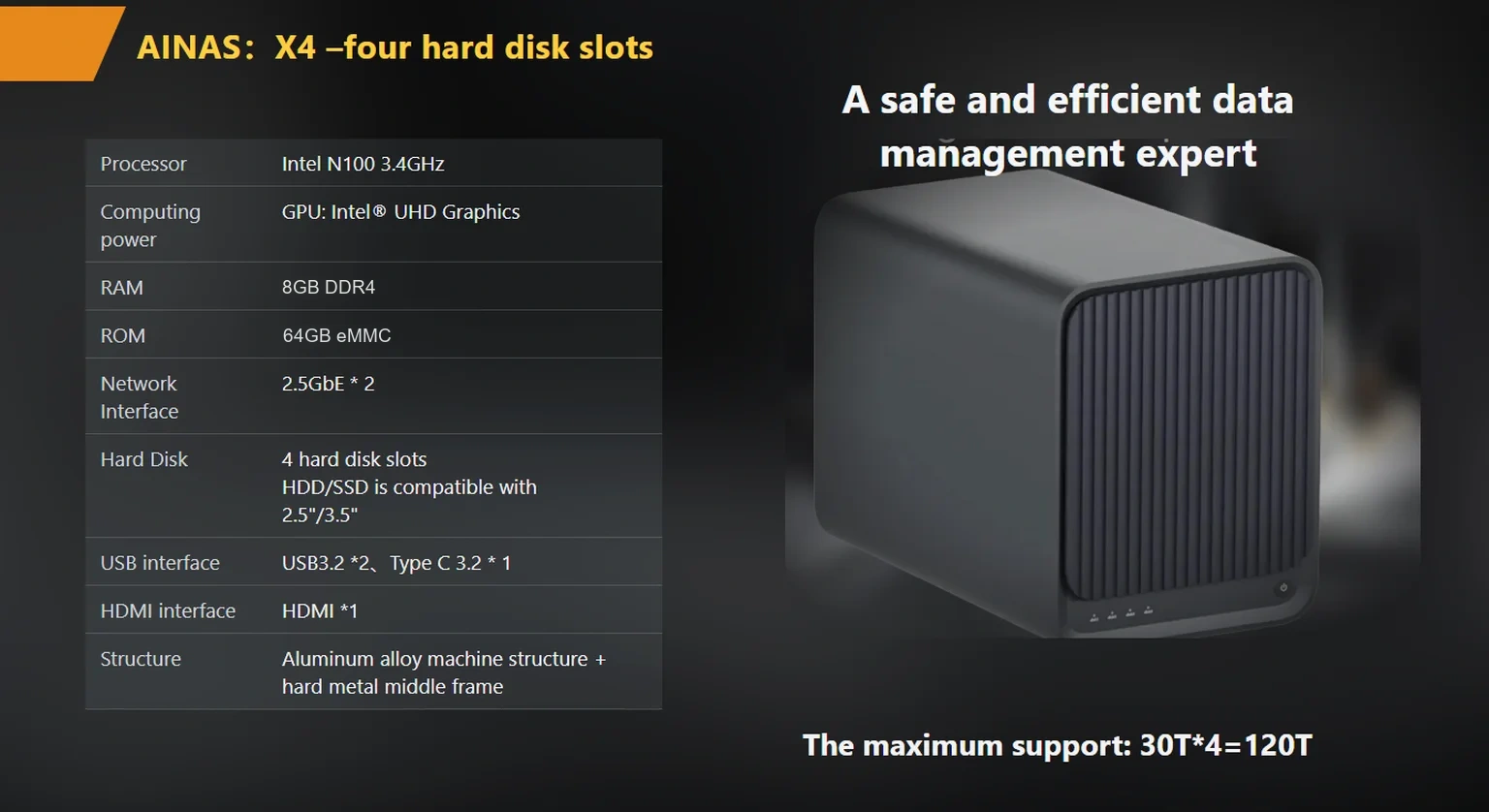
Memory ceiling. The N100 processor ships on the four-bay platform here with 8 GB DDR4 as standard and an OEM option to 16 GB. Read the ceiling as the option that has to be selected at order rather than a figure that can be added later. A device configured below the ceiling cannot host a local service next to a file share, and that decision is made at the specification stage.
Boot storage. Applications, container images and index snapshots live on the boot volume. A 64 GB eMMC boot volume with a factory option to 128 GB leaves room for growth; a small fixed volume turns the first large update into a rebuild.
Port layout. Two 2.5GbE ports that can be aggregated or used as failover paths, plus support for mixing 1GbE, 2.5GbE and 10GbE ports, let an integrator match the uplink to the site instead of replacing the appliance when the office network is upgraded.
| Decision | Number to pin down | Consequence if it is wrong | Where it lands |
|---|---|---|---|
| Can a local model run at all | Platform memory maximum | Model and index cannot both be resident; queries fall back to a cloud API | X4 — 8 GB DDR4 standard, OEM to 16 GB |
| Can services be updated in place | Boot storage size | Boot volume fills; update becomes a reimage and a maintenance window | X4 — 64 GB eMMC, OEM to 128 GB |
| Can several users query at once | Port count and port speed | Second user queues behind the first; retrieval latency becomes the complaint | X4 — 2 × 2.5GbE, aggregation or failover to 5 Gbps |
| Does storage keep pace with the corpus | Capacity ceiling and bay count | Corpus outgrows the chassis inside a budget cycle | X4 — 4 bays, up to 120 TB |
| Does the uplink match the site | Port-type mixing support | Appliance replaced when the office moves to 10GbE | X4 OEM — 1GbE / 2.5GbE / 10GbE mixing |
A worked example shows how the numbers combine, with sizes marked as placeholders: a 3 TB corpus (placeholder) and a 6 GB model (placeholder) — inputs the buyer knows and woCyber does not. The memory question is whether model, index and overhead stay under the platform maximum; the four-bay platform carries 8 GB DDR4 with an OEM option to 16 GB, so a project expecting a second release reads the 16 GB row off the option list. For storage, the corpus needs its size plus RAID overhead, so a 3 TB working set sits inside the 120 TB ceiling. Network comes last.
Fit is decided by corpus size and concurrent users, not by the model name, because a smaller corpus with fewer users lands on a dual-bay platform while a larger one needs the bay count and the dual-port layout of a four-bay appliance.
Two published configurations cover most projects:
For an office running retrieval over a modest document set, the S2 platform is the natural floor. Where the corpus grows and several users query at once, the four-bay X4 has the headroom. The question worth asking is which ceiling the project reaches first, not which platform looks faster on the specification sheet.
The contract should fix five items before tooling starts: which branding layers the buyer controls, who owns the moulds once they are paid for, what the firmware update path looks like, which approval gates sit between the sample and volume, and which compliance documents ship with each batch.
Two commercial points belong in the same document, which buyers ask about last. The platform publishes two order tiers: a per-project minimum where an existing platform is reconfigured, and a quoted threshold where a new PCB respin or a new mould is required. Both order thresholds are stated on the OEM page, while the price itself is quoted on request, so a brand can plan the batch size before it opens a pricing conversation. Samples follow a separate published rule: charged at the single-unit rate and credited against the first production order.

The cash cost of a pilot is the sample charge plus the certification and documentation work the buyer redoes under its own brand; the real constraint is the working capital tied up between the tooling deposit and the first sell-through, which is what the pilot is meant to measure.
Work the arithmetic in the order money leaves the business. Start with the unit cost basis, on request at order confirmation because configuration and volume set it. Add the one-time engineering charge, quoted per project and credited against volume at the agreed quantity. Add the sample units at the published single-unit rate, offset by the full credit against the first production order. Then add the listing work the buyer performs itself: EAN or UPC registration, energy and compliance labeling, WEEE registration and country-of-origin marking, on top of the CE, UKCA, FCC, RoHS, REACH and WEEE documentation that ships with the batch. A 100-unit pilot sits in the reconfiguration tier, so a brand can test a configuration in its own market before committing to a new mould.

Nothing in a quotation settles what constrains the build. The memory maximum and boot storage option decide which software fit; the port layout and its aggregation behavior decide how fast the corpus is read; the tooling ownership clause and the per-batch documentation set decide what the brand still controls in year three. Each is a number a price line does not carry.
A restore path belongs in the specification rather than an assumption, which is how the broader discipline treats it: the NIST Cybersecurity Framework lists recovery as a core function in its own right. In practice the request list is short: the specification page rather than the marketing summary, boot storage options named separately for standard and OEM, a one-line answer on port behavior under aggregation and failover, and a transfer trigger on mould ownership.
One structural point sits under every answer woCyber gives OEM partners. A brand selling a private AI appliance is buying the right to keep selling the same product under its own name for years, which is why tooling, firmware change control and documentation carry more weight than unit price. Brands can review the four-bay products/x4-nas-server, integrators the dual-bay products/s2-smart-nas; the products range shows where each sits, and program terms are on oem-odm.
Projects go wrong in four recurring places: the memory ceiling is read as installed memory, the pilot is sized to prove the concept rather than the business case, the firmware change path is left open, and the documentation pack is treated as a shipping detail instead of a listing prerequisite.
That explains why local inference appears in procurement conversations where cost is not the trigger. When a workload runs continuously and reads the company’s own documents, the question of who holds those documents is asked eventually — and an appliance that sits inside the customer’s network answers it structurally rather than contractually.
A requisition that compares cleanly repeats the same figures for every supplier: the memory maximum, the boot storage option, the aggregated port bandwidth, the capacity ceiling with its assumed RAID level, and the minimum order quantity beside the sample credit. Held constant, they turn a stack of quotations into a table a committee can read at a glance.
In this category the processor name gets the attention and the memory ceiling does the work. A brand that writes the memory maximum and the boot storage option into the requisition first, and treats the port layout as the third question, spends its engineering budget where the deployment actually breaks.
An on-premises LLM NAS OEM program specifies hardware so a local language model and its retrieval index run on the same box that serves files, under the customer’s own network. The distinction sits in the specification — memory ceiling, boot storage and port layout — not in a feature list.
woCyber builds a four-bay enterprise NAS server on the Intel N100 processor. The standard configuration carries 8 GB DDR4, with an OEM option to 16 GB, and 64 GB eMMC boot storage with an OEM option to 128 GB. Both figures are published on the platform page rather than quoted from a third-party specification.
The configurable layers are a white-label mobile app published under the buyer’s brand, a branded user interface and boot animation, logo application by silkscreen or laser engraving, branded firmware behavior for AI event rules and retention defaults, and branded over-the-air updates, with packaging and documentation localized to the target market.
The platform minimum order quantity is a per-project minimum where an existing platform is reconfigured, and a quoted threshold where a new PCB respin or new mould is required. Samples are charged at the published single-unit rate and credited in full against the first production order.
Moulds can be amortized into the unit price or invoiced separately, and ownership transfers to the customer once they are paid in full. Tooling made for one customer is not reused for another, and OEM pricing is on request rather than published.
The certification set covers CE, UKCA, FCC, RoHS, REACH and WEEE. Listing inputs including EAN or UPC coding, energy and compliance labeling, WEEE and producer-responsibility marking, and country-of-origin marking are supported. Warranty terms are confirmed in writing at quotation.
From a per-project minimum: white-label app, custom firmware, silkscreen or laser-engraved logo, market-specific documentation and packaging. Our export engineering team replies within one working day.
Key takeaways An FCC-recognized lab must hold the right scope for your device's rule part, not just any accreditation. A 2-bay NAS…
November 3, 2026Shared storage for deskside AI clusters refers to a storage appliance on the office LAN that holds datasets, checkpoints and embeddings for…
November 3, 2026A cloud storage subscription cost is the recurring fee a business pays to keep its files on a provider's servers, billed per…
Ask our export team for the OEM/ODM cooperation guide and a written quotation.
