Leo · 2026-10
Buyers who search for NAS import compliance EU requirements are usually after a list they can act on. Six categories of document and registration have to exist before a storage appliance is lawfully placed on the European market, and the manufacturer supplies only some of them.

This article is written for the importer, distributor or system house that signs the purchase order and inherits the rest. It sets out what to request from a supplier, what stays with the buyer under Regulation (EU) 2019/1020, and the points where a first shipment normally stalls.
The confusion is structural rather than careless. Most buyers assume compliance travels with the goods, like a warranty card in the box. It does not. The product carries a declaration; the market entry carries duties, and those duties attach to whoever places the appliance on the EU market.
That distinction explains why two buyers can import the same chassis and end up with very different files. One has a named person who owns the registrations. The other has a folder of PDFs and an unresolved question about who is supposed to produce them.
Responsibility is split, and the split comes from law rather than from the sales contract. The manufacturer declares product conformity and assembles the technical documentation. The importer who places the goods on the EU market is itself an economic operator with duties of its own, including verifying that conformity assessment has been carried out and that the manufacturer’s name and address appear on the product.
Where the importer is also the brand owner, the two roles collapse into one organisation and nothing feels ambiguous. Where a distributor imports under a supplier’s brand, the roles stay separate and the file has to be assembled deliberately.
Practically, three questions decide how much work this is:
Request a named document for each obligation, not a general assurance that “compliance is covered”. Six categories cover the NAS import compliance EU requirements for a desktop appliance sold into the EU.
Ask for the revision identifier on every document. A conformity file that describes revision A while the container holds revision B is an audit finding waiting for a date.
The table below sorts the same items by stage rather than by type, because the stage is what determines who has to act.
| Stage | What to request | Where it comes from | What it costs if absent |
|---|---|---|---|
| Before the quotation is accepted | EU Declaration of Conformity, listing the directives applied and the model revision | Manufacturer | Quotes cannot be compared on a like-for-like basis |
| Before the production order | EMC test report for the exact revision being ordered | Test laboratory engaged by the manufacturer | A later revision change invalidates the evidence |
| Before the production order | Radio test evidence for any model with Bluetooth or Wi-Fi | Test laboratory engaged by the manufacturer | The configuration cannot lawfully be placed on the market |
| Before shipping | RoHS and REACH declarations covering the delivered configuration | Manufacturer, from supply-chain data | Component substitutions pass unrecorded |
| Before the first sale | WEEE producer registration for each member state of sale | Producer or authorised representative | No registration number can appear on sales documents |
| Before the first shipment leaves | Packaging scheme registration for the country of sale | Producer or importer | Units reach the market before the filing exists |
| For any GB-facing SKU | UKCA evidence and the UK importer’s details | Manufacturer | The EU file is assumed to cover Great Britain |
Every entry in the last column is a documentation-timing problem rather than a hardware problem, and timing problems are cheap to fix before the production order and expensive to fix after the container sails.
CE marking is not a certificate issued by a European authority. For most product categories it is a self-declaration: the manufacturer performs or commissions the conformity assessment, signs the declaration, and carries legal responsibility for it. The European Commission’s own guidance on CE marking describes it in those terms.
This matters at procurement stage for one reason. A supplier that presents a CE “certificate” from a commercial body as the legal basis for market entry is describing a document that does not carry that legal weight. What carries weight is the declaration, plus the technical file behind it.
It belongs in a separate conversation from product conformity, and mixing the two is where European buyers get misled most often. Data protection is not a product certification. There is no certificate that makes an appliance compliant with the General Data Protection Regulation, and any supplier offering one is offering something that does not exist in that form.
What can be verified instead is architectural. Does the appliance process data inside the customer’s own environment? Is access controlled per account? Can the operator keep an access audit trail? Those are the questions the buying organisation can answer for its own records, and they are the ones a supervisory authority will ask about.
Ask for the deployment model in writing instead. Two answers decide how much of the story rests on architecture rather than on paperwork: whether the appliance operates without an outbound connection, and whether access records are held on the device itself.
Compliance work costs money, and the arithmetic is simple enough to run before the first quote is approved. The formula below is illustrative, and every rate in it is a variable the buyer sets.
Landed cost = (goods value + freight + duty) × (1 + import VAT rate)
Take an illustrative order of 100 dual-bay units, the S2 in this example, invoiced at the published single-unit reference price of $195, giving a goods value of $19,500. Freight is entered here as $1,200, which is a figure for the example rather than a quoted rate. The duty rate is likewise a reader-set variable, put at 2% for the calculation, which adds $414 to the base. That produces a VAT base of $21,114, and at a 21% rate assumed for this example the VAT on the consignment is $4,433.94.
Total landed cost works out at approximately $25,548, or about $255 per unit before onward distribution. Volume and OEM pricing sit outside this figure and are quoted on request, with a minimum order quantity of 100 units.
Run the same formula with freight entered at $2,400 and the per-unit figure moves to roughly $270. Nothing about the appliance changed. That is the point of doing the arithmetic early: it tells you how much room the freight negotiation is worth.
Consider a hypothetical 22-person system house in North Rhine-Westphalia that wins a project to standardise file storage across three municipal offices. The integrator orders 100 units, accepts the supplier’s conformity documents in week one, and schedules installation for week six.
What delays the handover is not the hardware. At commissioning, the client’s own records officer asks for the WEEE registration number that should appear on the sales documentation, and for the declaration covering the exact model revision delivered. The integrator had never registered as a producer in its own name, because the assumption was that the supplier’s CE file closed the whole question.
Two weeks pass. The fix is administrative, not technical, and it costs more than the registration would have.
The trade-off the integrator faced was the familiar one: spend half a day assigning registrations to a named person before the production order, or spend two weeks of project schedule afterwards. If a buying organisation can only do one compliance task before ordering, that task is deciding who owns the national registrations.

Yes, and treating Great Britain as a copy of the EU route is the usual mistake. UKCA marking applies to goods placed on the GB market, and the UK importer carries the corresponding duties. The UK government publishes its own guidance on using the UKCA marking, and Northern Ireland follows a distinct arrangement again.
A SKU sold in both markets therefore needs both files, with the same discipline about revision identifiers.
Four phrases are worth challenging in writing during supplier evaluation:
Put those four questions in writing during evaluation, and file the replies with the registration documents rather than in an email folder.
Documentation is half the sourcing question. The other half is whether the platform behind it can be supported across the life of the project.
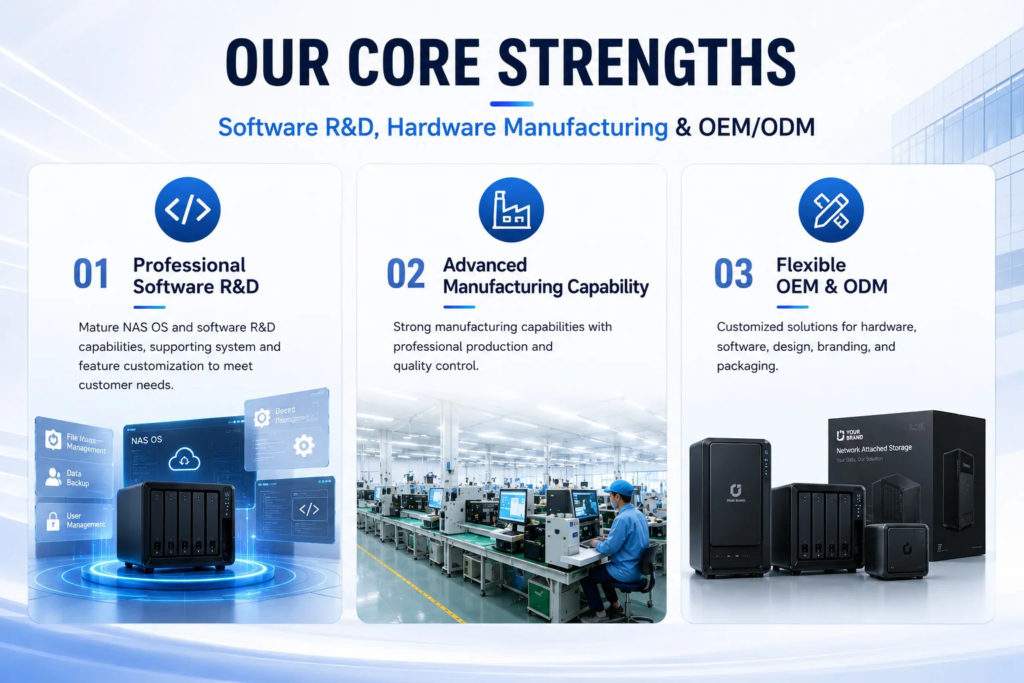
woCyber runs its research and development in Beijing and its mass-production manufacturing in Shenzhen. For a buyer assembling the file described above, the material that counts is the documentation set: the declaration of conformity, test evidence for EMC and radio where applicable, RoHS and REACH declarations, and WEEE producer details. The certification set published for the product lines is CE, UKCA, FCC, RoHS, REACH and WEEE. At order level the OEM programme covers white-label applications, brand user interfaces, and localised documentation and packaging, a route covered in more detail in what-is-oem-nas-manufacturing.
Where four bays and a dual 2.5GbE link are the requirement, the X4 4-Bay Enterprise NAS Server is the platform we point integrators towards. Whatever model ends up on the shortlist, the same check applies: request the revision identifier printed on the declaration of conformity, then compare it with the label on the sample unit. The products hub lists the bay count and capacity ceiling of every model, so a shortlist can be built against the retention figure the buyer has already committed to. Buyers comparing suppliers on documentation quality rather than on headline specification may also find the sourcing questions in european-nas-manufacturer useful as a written checklist.
woCyber charges samples at the published single-unit reference price and credits the amount in full against the first production order, so the documentation review can be run on real units rather than on PDFs. The compliance file is a supply-chain artefact, and it is worth treating it as one from the first conversation.

They treat it as a purchase condition instead of a project deliverable. A purchase condition is satisfied by a folder arriving by email. A project deliverable has a date attached to it.
The file that survives a review is the one assembled before production, not the one reconstructed afterwards. Reconstruction is possible, and it runs on other people’s calendars, which is why it costs weeks rather than days.
The declaration of conformity is the anchor document, and the national registration most likely to be missing in the country of sale is the one worth chasing next. A file assembled before production closes quickly. A file reconstructed afterwards closes on other people’s timetables.
We are the factory: SMT to shipment under one roof, R&D in Beijing, mass production in Shenzhen. Factory-direct pricing without trading-company markups.
 Browse all platforms →
Branding starts last on a multi camera AI NVR OEM platform, not first. The order that holds up: camera count in writing,…
November 19, 2026NAS sourcing for US importers lives or dies on documentation: the certification file, the shipping paperwork, and the commercial terms confirmed in…
November 19, 2026A self-hosted cloud appliance keeps your files on hardware you own and still serves them to every device you use. This verification…
Ask our export team for the OEM/ODM cooperation guide and a written quotation.
