Leo · 2026-09
A NAS distributor wholesale program North America resellers can build around has to answer four questions before price: which SKU tiers exist, how territory is protected, who holds spare parts, and which listing files arrive with the shipment. This guide covers each in turn, and shows how to size a first order from published figures alone.
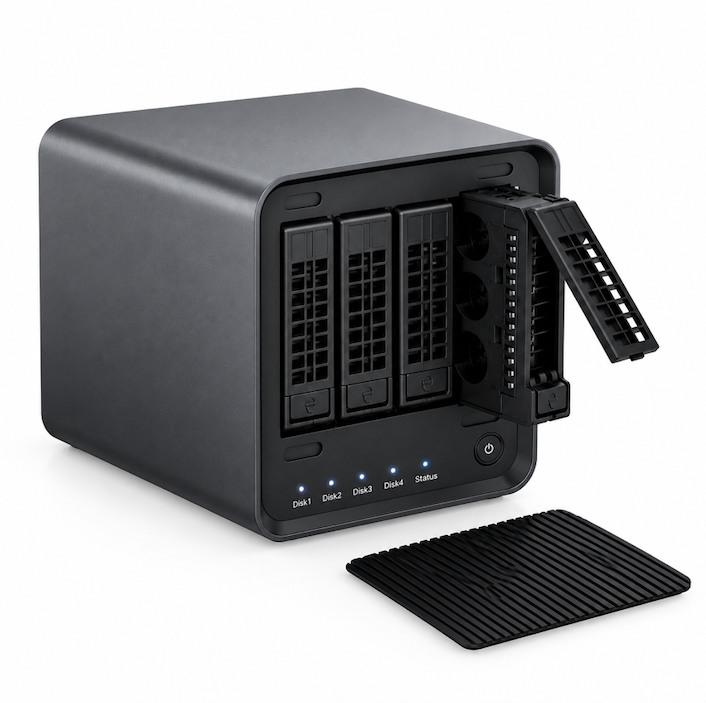
A wholesale program is the commercial wrapper around a hardware platform: it fixes the tiers you may list, the territory you may hold, and the parts path that sits behind the product once it reaches a shelf.
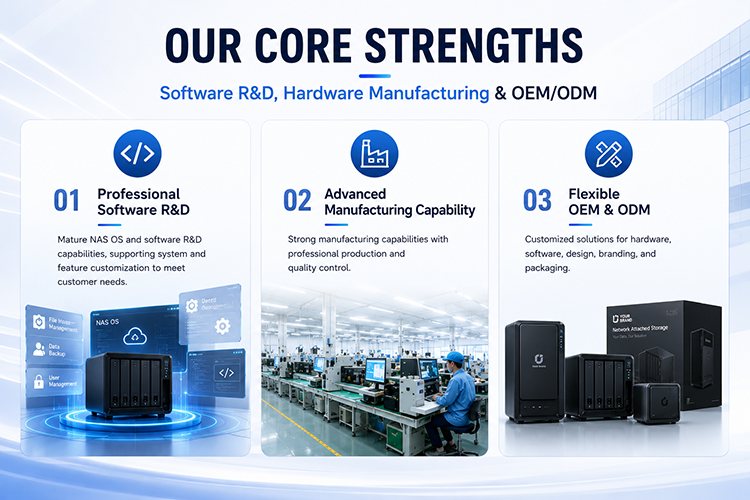
woCyber, the export brand of a Beijing-based storage hardware manufacturer that runs mass production in Shenzhen, publishes the moving parts of that wrapper. Reconfiguration orders start at 100 units per SKU. Projects that require a new PCB respin or enclosure tooling start at 1,000 units. Tooling is either amortized into the unit price or invoiced separately, and ownership transfers to the buyer on final payment. Non-recurring engineering is quoted per project and credited once agreed volumes are reached. Payment runs at 30% with the order and 70% against the bill of lading.
Those five lines are what a purchasing team should be able to read out loud before it signs anything, and they sit in one place: the published OEM and ODM program terms. Because the same terms sit behind every platform, a buyer is not negotiating a fresh commercial model for each SKU — which is what makes a channel catalog predictable to price.
Start with the two ends of the ladder, one entry model and one four-bay flagship, because the middle of the range sells itself once the extremes have produced sell-through data.
The decision that shapes a NAS distributor wholesale program North America buyers run is how wide the listed range should be at launch. The table below sets out the published reference prices; they are per unit in USD, exclude shipping and duties, and can change. Volume and OEM pricing is quoted on request.
| Model | Bays | Network port | Capacity ceiling | Published reference price | Channel role |
|---|---|---|---|---|---|
| A3 Pro | 1 | 1 × GbE | 30 TB | $150 | Entry tier; edge and kiosk listings |
| A2 Pro | 2 | 1 × GbE | 48 TB | $170 | Compact tier; broadband and smart home bundles |
| S2 | 2 | 1 × 2.5GbE | 60 TB | $195 | Mainstream retail tier |
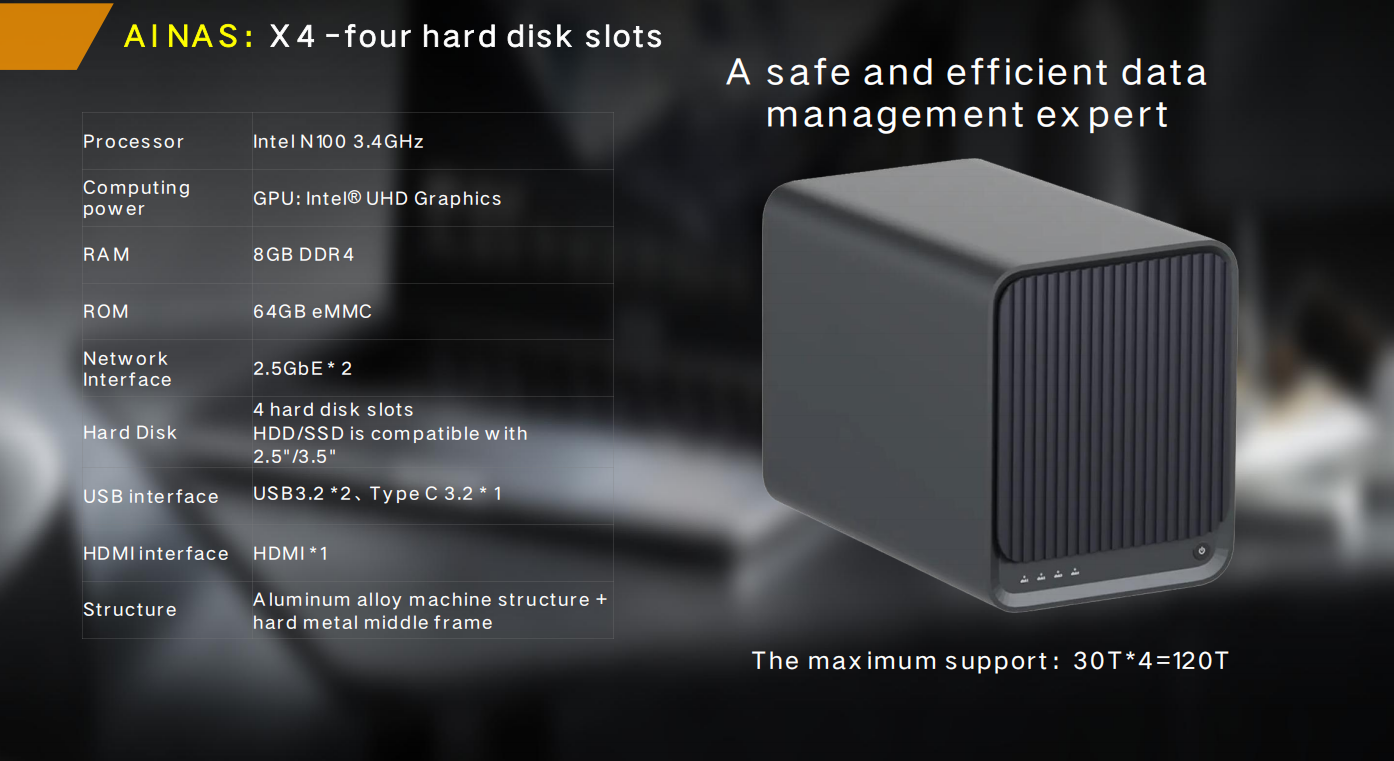
| X4 | 4 | 2 × 2.5GbE with link aggregation or failover up to 5 Gbps | 120 TB | $400 | Prosumer and small business top tier |
Two features of that ladder change how a distributor buys. First, the two-bay tier is where service-provider bundling lives: A2 Pro is positioned for broadband and smart home service packages, so the buyer in that tier is often an internet provider rather than a store. Second, the four-bay tier carries both the highest absolute price and the highest accessory attach rate, which is why it earns shelf space even when its unit volume is the lowest of the four.
Where the goal is an own-brand product rather than a distributed line, the same platform family is delivered through a private label program for US brands, which keeps the hardware identical and moves the branding instead.
Size it on cost per terabyte of listed capacity rather than on unit price, because the capacity ceiling is published while the wholesale discount is not.
Use one formula: reference price per terabyte = published reference price ÷ maximum supported raw capacity. Applied to the four platforms, that gives:
The result describes the enclosure, not the storage. The ceiling assumes the bays are fully populated and the drives are bought separately, so treat these four figures as a comparison of platform economics rather than as a landed cost.
Now consider a hypothetical 14-person regional distributor in Ohio that already carries networking and IP camera lines and is weighing whether to add storage. Its purchasing lead has two offers on the desk: a reconfiguration program at the 100-unit tier, and a full ODM program at 1,000 units with a custom enclosure. The tradeoff is not price. It is whether a 1,000-unit commitment can clear inside the freight cycle she is already paying for. The compromise she takes: list the two-bay platform at 100 units, hold the four-bay flagship for project bids, and revisit tooling only after two quarters of sell-through.
Territory protection is worth more because exclusivity is negotiated against a committed annual volume and written into the distribution agreement; it is never granted by default.
Territory terms are also the clause a NAS distributor wholesale program North America partners argue about most, because they decide whether two resellers in the same metro area undercut each other on the same model. Ask for the commitment schedule in the same document as the price tier, and read the confidentiality section with it: woCyber does not disclose customer identities, and where written regional exclusivity is agreed, the same configuration is not supplied to another customer in that region.
For a distributor, that clause is worth more than a marginal discount. It is the difference between defending a margin and matching a competitor’s price every quarter.
Hardware carries a 3-year warranty and spare parts are supplied across the project lifecycle, which is the line that keeps a SKU listable after the launch year.
A NAS distributor wholesale program North America resellers can keep listing for years depends on evidence as much as on paperwork. Every unit passes functional test, a 72-hour burn-in test chamber and 100% outgoing inspection, and the inspection reports are archived per batch. When a reseller returns a dead unit, that archive is the difference between a warranty claim and a conversation.
It is worth asking how the parts path is priced as well. A program that ships a replacement board is far cheaper to run than one that swaps an entire unit, and the answer belongs in the agreement rather than in an email thread.

The document set is CE, UKCA, FCC, RoHS, REACH and WEEE, the ISO 9001 certificate for the quality system, and an ONVIF conformance statement for camera interoperability, plus the retail listing data.
Listing data means EAN and UPC codes, energy and compliance labels, WEEE and producer-responsibility marking, and country-of-origin marking. Packaging can be specified in FSC-certified board with plastic-free inserts, and interfaces can be localized across EN, DE, FR, IT, ES, JA, KO and FI.
On the North American side, radio and interference requirements sit with the FCC equipment authorization program under 47 CFR part 2, so request the test reports that match the exact configuration ordered rather than the platform family. Camera interoperability is a separate question again, and the ONVIF specification is the reference to hold any supplier to.
woCyber lists the certifications above and no others. A compliance review at a retail buyer will ask for exactly this pack, and unsupported claims do not survive that review.
Match the platform to the deployment rather than to the price list: single-drive units for edge and kiosk listings, two-bay units for households and small offices, and four-bay units for prosumer work and project bids.
For the top of the ladder, the X4 4-bay enterprise platform is built on an Intel N100 processor, which Intel lists as a 4-core part with 6 MB of cache, Intel UHD graphics and Quick Sync Video. It ships with 8 GB DDR4 memory expandable to 16 GB under OEM configuration and 64 GB eMMC boot storage expandable to 128 GB, with a 120 TB capacity ceiling. Two 2.5GbE ports can be aggregated or run as failover for up to 5 Gbps, and 1GbE, 2.5GbE and 10GbE configurations can be mixed. Storage takes tool-less 2.5-inch and 3.5-inch trays across RAID 0, 1, 5, 6 and 10. The chassis is aluminum over a steel mid-frame with active multi-fan thermal control, and hardware 4K transcoding and container support are part of the platform.
For the mainstream tier, the S2 dual-bay smart storage hub combines an RK3568 processor with a 1 TOPS NPU for on-device inference, 32 GB eMMC boot storage, a 60 TB ceiling, a single 2.5GbE port and an ABS shell over a rigid steel mid-frame that damps drive vibration. At 105 × 228.5 × 170 mm it is a shelf-sized unit, which is why it is usually the first model a distributor lists.
Buyers who want to verify the factory before listing anything should work through the same steps as brands vetting NAS server manufacturers, starting with batch records rather than with the quotation.
Five questions separate a workable channel program from a price list. The answers below come from woCyber’s published terms.
Reconfiguration starts at 100 units per SKU; from 1,000 units where a new PCB respin or enclosure tooling is required. The threshold applies per SKU, so a distributor can open with one model and add others after sell-through data arrives.
The buyer does. Tooling can be amortized into the unit price or invoiced separately, and ownership transfers on final payment. Customer-specific tooling is not reused for other clients.
Samples are charged at the published unit price and the fee is credited in full against the first mass-production order, so the sample line nets to zero once the program converts.
30% with the order and 70% against the bill of lading. Regional exclusivity, if requested, is negotiated against a committed annual volume and written into the distribution agreement rather than granted by default.
Yes. The 100-unit reconfiguration tier exists for that purpose, and it applies per SKU rather than to the whole catalog, so a buyer can test one platform before adding a second. The manufacturing and quality process behind both tiers uses the same lines, the same burn-in chamber and the same outgoing inspection.
The platform family has shipped more than 500K units across 30+ export markets over 15+ years of B2B storage manufacturing, with monthly capacity scalable to 20,000+ units per month. For a distributor, the question that matters is whether a factory can hold that cadence through a launch quarter, and the answer is on the production floor rather than in the price list.
We are the factory: SMT to shipment under one roof, R&D in Beijing, mass production in Shenzhen. Factory-direct pricing without trading-company markups.
White Label NAS Program for Regional Distributors: SKU Ladder, Branding Rights and Launch Costs A white label NAS for regional distributors is…
October 1, 2026Retail NAS SKU for Big Box Channel Partners: How Retailers Specify a Storage Line A retail NAS SKU for big box channel…
September 30, 2026NAS Manufacturing USA: Sourcing Guide for 2026 Brands Most NAS manufacturing USA comparisons start with the assembly line. The invoice disagrees. On…
Ask our export team for the OEM/ODM cooperation guide and a written quotation.