Leo · 2026-09
An AI NAS OEM partnership lets a brand sell intelligent private-cloud storage under its own name while the manufacturer handles design, certification and production. woCyber, the export brand of a Beijing-based storage hardware manufacturer, offers AI NAS OEM programs covering 2-bay compact appliances and surveillance-ready kits, with MOQ from 100 units.
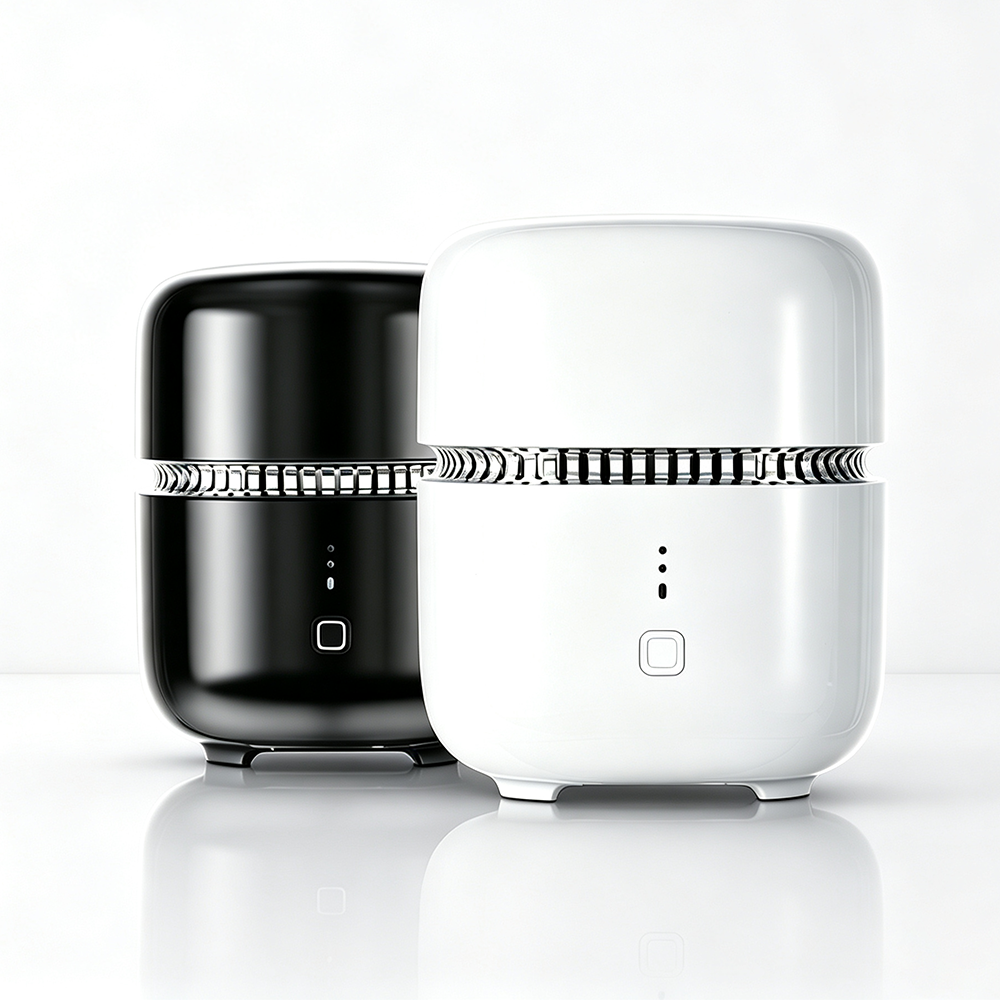
Buyers searching for an AI NAS OEM partner usually face the same decision: invest in an in-house hardware team, or source a proven platform and put a brand on it. This guide answers the questions distributors, security brands and regional IT suppliers ask before signing an OEM agreement — what gets customized, what the platforms actually contain, and how to evaluate a manufacturer before committing volume.
An AI NAS OEM partnership is an arrangement in which a storage hardware manufacturer produces AI-capable NAS appliances that the buyer sells under its own brand. The manufacturer contributes the hardware platform, operating system, AI features, certification work and mass production; the buyer contributes market access, brand identity and channel relationships.
woCyber operates as an OEM / ODM only business — the company does not run a consumer retail brand and does not compete with its channel partners. Minimum order quantities start from 100 units per order, which keeps entry barriers low for regional distributors testing a first SKU. Engineering leadership comes from a founder who graduated from the Computer Science department of Peking University, and the manufacturing organization behind the brand carries 15 years of B2B storage hardware experience, headquartered in Beijing with mass production in Shenzhen.
OEM differs from ODM mainly in who owns the product definition. Under an OEM model the buyer typically selects and rebrands an existing platform; under an ODM model the manufacturer develops hardware or firmware variants to the buyer’s specification. woCyber supports both paths on the same platform base, which matters for brands that want to start with a stock model and diverge later.
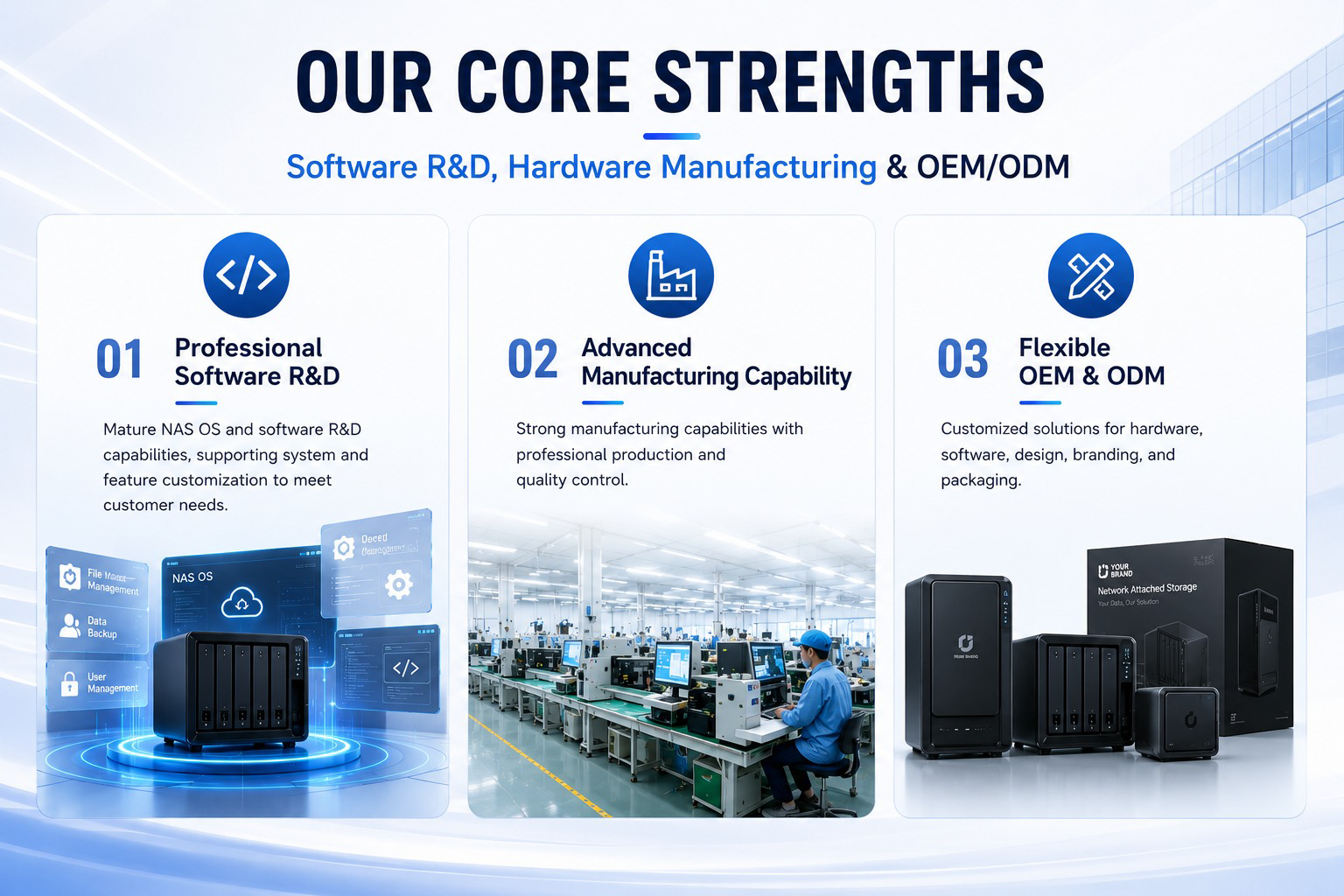
Branded resale through an AI NAS OEM partner reaches the market faster and with lower engineering risk because the complete stack already exists. A competitive AI NAS product requires competence in four stacked layers, and each layer alone can take years to build:
A brand that sources through OEM buys all four layers in one agreement. The alternative — assembling a hardware team, licensing or writing a NAS operating system, training AI models and running certification — consumes budget before the first unit ships. For a distributor building a SKU ladder, the OEM route turns storage into a repeatable product line instead of a one-off engineering project.
AI is the layer where the gap is widest. Local AI photo organization — face, location, event and time classification — must run on the device itself to keep user data private and to work offline. Reproducing that feature set on a cloud subscription model would add recurring cost to every customer, while an on-device implementation ships as standard on the platform.
An AI NAS OEM partner customises industrial design, hardware configuration, firmware, client applications and packaging — the full scope needed to ship a distinct branded product. woCyber structures customization around six service areas: product design, hardware customization, firmware development, APP customization, packaging customization and mass production.
On the A2 Pro platform, the published OEM options matrix shows what that means in practice:
Firmware tiering deserves emphasis for multi-market distributors. One hardware platform can ship as a basic backup appliance in a price-sensitive market and as a fuller private-cloud product in a premium market, purely through feature-set selection at the firmware stage. A single OEM agreement therefore supports several retail price points without new tooling.
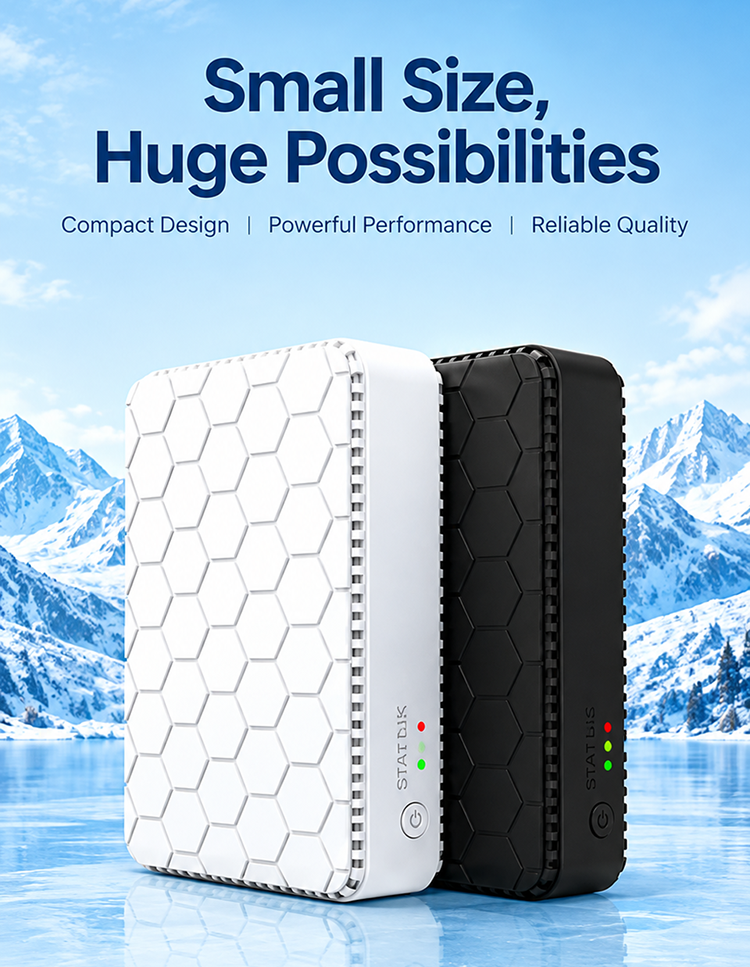
Evaluating an AI NAS OEM manufacturer comes down to six verifiable criteria, and each one can be checked during the first quotation exchange rather than discovered after the first shipment.
Ask for the exact SoC, memory, drive-bay configuration and maximum capacity of each platform. A manufacturer confident in its hardware publishes these numbers. woCyber’s A2 Pro, for example, is documented as a Rockchip RK3568 quad-core Cortex-A55 platform up to 2.0 GHz with a 1 TOPS NPU, 4 GB DDR4 memory, two 2.5-inch SATA bays and a maximum raw capacity of 48 TB.
Confirm where the AI models physically run. Features that require an internet round-trip add recurring cloud cost and weaken privacy claims. Platforms should classify faces, scenes, events — or persons, vehicles and pets on surveillance units — locally on the appliance.
Export projects need CE, UKCA, FCC, RoHS, REACH and WEEE support as a baseline, and security-focused products additionally benefit from GDPR-oriented data-locality documentation. Certification scope is part of the woCyber OEM options matrix, not an afterthought.
A white-label product only works if the UI skin, boot animation, app-store identity and OTA channel carry the buyer’s brand. Confirm that the mobile app can be published under the buyer’s name in the app stores.
MOQ from 100 units allows a first-market test. Ask how the same platform tiers into multiple SKUs through hardware variants and firmware feature selection — that ratio determines gross margin across the ladder.
A manufacturer that also sells retail competes with its own OEM customers. Confirm the OEM-only policy in writing before sharing a market plan.
The A2 Pro serves value-tier private-cloud retail, while the S1 targets security brands that need an edge AI recorder with private-cloud storage. The table below lists only specifications published on the woCyber product pages.
| Item | A2 Pro — 2-Bay Compact NAS | S1 — AiNAS Security Kit |
|---|---|---|
| Positioning | Value platform, entry price point | AI surveillance platform (AI NVR + private-cloud NAS) |
| Processor | Rockchip RK3568, quad-core Cortex-A55 up to 2.0 GHz | Edge AI SoC (model not published — request datasheet) |
| AI acceleration | 1 TOPS NPU, Mali-G52-2EE GPU | On-device edge inference, false-alarm filtering below 3% |
| Memory | 4 GB DDR4, 16 GB eMMC boot | Not published — request datasheet |
| Storage | 2 × 2.5″ SATA, RAID 1, up to 48 TB raw | Multi-bay, multi-disk pooling, external drive and USB ingest |
| Network | 1 × GbE RJ45 | Not published — request datasheet |
| Surveillance | ONVIF / PoE IP camera support with on-appliance AI event classification | ONVIF / PoE IP cameras; person, vehicle and pet classification; 7 / 14 / 30-day retention profiles; two-way audio |
| AI features | On-device face, scene and event models; AI photo organization | AI-structured event search with color timeline and metadata |
| Target buyer | Consumer / SOHO retail, ISP bundles, regional distributors | Security and alarm brands, integrators, smart-home ecosystems |
Where a specification is not published, the table says so rather than estimating. Requesting the full datasheet for the target platform is a standard step in the OEM quotation process.
The woCyber OEM process runs through six defined stages from market brief to mass production, and each stage produces an artifact the buyer reviews before the next one starts.
Buyers normally enter the process with three inputs: target market, target volume and channel type. Those inputs determine platform choice — A2 Pro for value-tier retail, S1 for security propositions — and the depth of customization at each stage.
AI NAS OEM pricing is driven by five project-level variables rather than a fixed list price, which is why manufacturers quote against a configuration instead of a catalogue number.
Platform positioning frames the conversation: the A2 Pro is documented as the entry price point of the woCyber NAS line-up, while the S1 kit bundles an AI hub with camera-program economics for the security channel. A quotation based on the five variables above gives the buyer a transparent view of where every cost sits.
Branded AI NAS lines fit six buyer profiles that woCyber’s platforms were mapped against: value-tier consumer brands, regional IT distributors, broadband and ISP bundling programs, small-studio and SOHO channel resellers, education and SMB entry projects, and emerging-market export programs.
Security-oriented buyers — alarm brands, security integrators, smart-home ecosystem companies, property managers, retail loss-prevention suppliers and insurance-linked home-monitoring programs — map to the S1 platform instead. For European programs, GDPR-sensitive positioning is supported by account-isolated storage architecture and data-locality documentation, so privacy claims rest on product architecture rather than marketing language.
Minimum order quantities start from 100 units per order at woCyber. The threshold applies to the OEM platform programs and keeps the entry barrier low for regional distributors and brand owners testing a first SKU. Volume tiers, hardware variants and firmware feature selection are then negotiated in the configuration proposal that accompanies the datasheet.
AI features on the woCyber platforms run on the device. Face, scene and event models execute on the appliance itself, so AI albums, event classification and surveillance detection keep working offline. No user photo, video or metadata has to leave the device for the AI features to function, which supports privacy-led product claims in regulated markets.
woCyber platforms ship with CE / UKCA / FCC / RoHS support as the baseline, plus REACH and WEEE documentation work within the OEM compliance scope. Security-focused programs add GDPR-oriented data-locality documentation. Buyers should confirm the certification checklist for their destination market during the quotation stage, before tooling starts.
woCyber operates as an OEM / ODM only business and does not run a consumer retail brand. The company designs, certifies and mass-produces for brand owners, distributors and system integrators, so an OEM partner’s product does not compete against a rival line from the same manufacturer in the same channel.
Firmware feature-set selection allows one hardware platform to be tiered into multiple market variants. The A2 Pro platform, for example, supports feature-set selection for market tiering within its OEM options matrix, alongside single-bay and 2-bay hardware variants. Distributors use this to build a SKU ladder without additional tooling cost per tier.
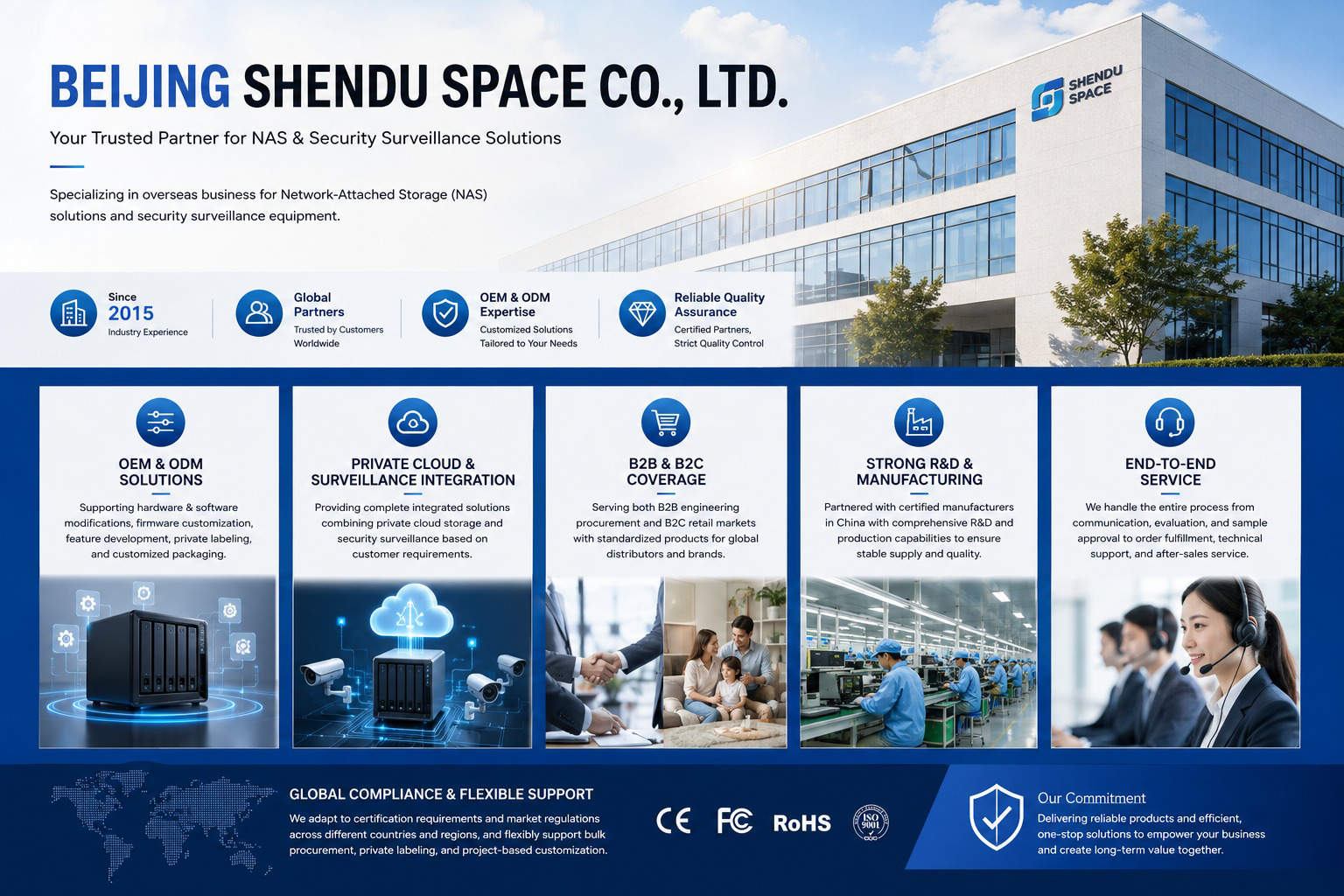
An AI NAS OEM program starts with a configuration proposal, not a contract. Buyers share target market and volume; the manufacturer returns the full datasheet, the OEM options matrix and a unit configuration. The woCyber OEM / ODM service overview and the A2 Pro platform page and S1 security kit page document the platforms described in this guide. Camera-protocol details follow the ONVIF standard, and European data-protection positioning aligns with GDPR requirements.
White Label NAS Program for Regional Distributors: SKU Ladder, Branding Rights and Launch Costs A white label NAS for regional distributors is…
October 1, 2026Retail NAS SKU for Big Box Channel Partners: How Retailers Specify a Storage Line A retail NAS SKU for big box channel…
September 30, 2026NAS Manufacturing USA: Sourcing Guide for 2026 Brands Most NAS manufacturing USA comparisons start with the assembly line. The invoice disagrees. On…
Ask our export team for the OEM/ODM cooperation guide and a written quotation.